‘My friends, we are going into a terrible danger, and we need arms of many kinds. Our enemy is not merely spiritual…A stronger man, or a body of men more strong in all than him, can at certain times hold him; but yet they cannot hurt him as we can be hurt by him. We must, therefore, guard ourselves from his touch. Keep this near your heart”—as he spoke he lifted a little silver crucifix… . (emphasis mine)
“Our enemy is not merely spiritual.” Hmmm. Another strike against the argument that Dracula was just an ethereal emanation called into life by the characters’ fears or desires. But that was a point made in the previous post, so I shall move onward.
In Dracula, the characters learn that the soul of one who has been overtaken by the vampire becomes lost for eternity, therefore lending urgency to the quest to stop Dracula and to save Lucy—who, unfortunately, becomes one of the undead, and must therefore not only be staked but beheaded in order to save her soul. Then Mina becomes the vampire’s next victim, and the race ramps up.
From an e-mail to a friend, written shortly after reacquainting myself with the classic novel:
The whole “damned forever” idea bugs me. So does the notion that a person could become damned without having a choice in the matter, as happens to Lucy in Dracula, or that repeated prayers to God for salvation from such evil / damnation (as are also given in the novel) would not result in Him stepping into the situation and saving anyone who asked Him. After all, He’s not willing that any should perish, and He has provided a way of escape. Our bodies may die, but our souls need not be damned. However, though “the good guys” win in the end, God is not really in the picture as the ultimate good standing in aid of humanity against ultimate evil.
Why, then, does holy water work? Or a crucifix? Or a Communion wafer? In reality, there’s nothing inherently powerful in the objects themselves. They are metal or flour or liquid. Nothing much to fear there. So, the power must come from what or Whom they represent.
However, where’s the power in the objects if the Deity in Whose name they are employed does not answer the prayers of those who call on Him? After all, He lets Lucy be taken, right?
One may argue He doesn’t answer because He doesn’t exist; or, if He does, He’s not intimately involved with the lives of humans. Why, then, the vampires’ reactions to the items employed in the search-and-destroy mission? It’s as if Stoker wanted the story both ways: God was the ultimate good Whom the vampires couldn’t tolerate, and yet humans—frail and prone to failure already in this endeavor—are the ones whose efforts finally succeed.
In the time since writing the message quoted above, I have come to a slightly different conclusion about the story. God is the unacknowledged character throughout, and I am reminded of all the times in real life in which I wanted to be rescued—and there have been many times I have been, some of them miraculously and as a direct result of prayer—but constant rescue would make a person passive, make him think he is entitled, make her think she need not put forth any effort.
We know a new butterfly must struggle to leave its cocoon—the struggle strengthens its wings. Therefore, we can take courage from the realization that, although we may be rescued or helped at various times in our lives, it is the striving that makes us strong. And makes us that much more grateful when help is offered.
Although I still think the novel’s theology is “off” concerning the soul and salvation, I see the real-life parallels to vampires: activities that suck away our time, people that subvert our successes or leech away our energy, attitudes or behaviors that drain us of joy or ambition or strength.
‘…Oh, but I am grateful to you, you so clever woman. Madam’—he said this very solemnly—’if ever Abraham Van Helsing can do anything for you or yours, I trust you will let me know. It will be pleasure and delight if I may serve you as a friend…all I have ever learned, all I can ever do, shall be for you and those you love. There are darknesses in life, and there are lights; you are one of the lights. You will have happy life and good life, and your husband will be blessed in you.’
In the last installment concerning this topic (part 1 can be read here), I expressed my doubts that Bram Stoker was making any sort of point about female sexuality in his classic horror novel.
Of all the commentary presented in the edition of Dracula I read, the material I can most readily accept as being part of Stoker’s intentional vision for the material is the inclusion of possible jabs concerning the tensions between Ireland and England*. As a writer, I have included names or versions of events that are jokes or jabs or homages, and it’s kinda fun when a reader recognizes them, too, and tells me so.
But over-analyzing the work of a long-dead author can lead us in directions he or she never intended. And he or she, being dead, cannot correct our errors.
I find it interesting that no mention was made to the Biblical allusion in the above dialogue from Van Helsing, which also later includes this:
‘Your husband is noble nature, and you are noble too, for you trust, and trust cannot be where there is mean nature.’
The Biblical reference that came to mind when I read this passage is found in Proverbs 31, verses 28 and 29:
Her children arise and call her blessed; her husband also, and he praises her: “Many women do noble things, but you surpass them all.”
Funny. Among all the other bits of trivia, historical references, suggestions of repressed sexuality, that didn’t make it into Valente’s notes at the back of the book.
Euripides, a Greek playwright from way back, said this: “Question everything. Learn something. Answer nothing.” So, I’m questioning.
Valente also asserts that, since Dracula casts no reflection in a mirror, he doesn’t really exist.
The notion of the immortal count being only a projection of one’s inhibitions or subconscious desires doesn’t stand. After all, Stoker writes that Dracula has been around for centuries before the novel’s characters meet him, and he has been served by the gypsies for generations. Sounds pretty corporeal to me.
Valente states in the notes, “The manner of Dracula’s death tends to confirm his status as a psychic emanation rather than an autonomous being.”
Uh, you sure about that? He crumbles into dust. As in “from dust we were made, to dust we shall return.” Again, sounds pretty corporeal to me.
There is also an argument made that blood in the novel can be seen as a metaphor for racism i.e. “bad blood” that is undesirable for mixing with one of pure blood.* That, and the fact that Dracula is proud of his varied and warrior heritage. I can sorta see that idea (refer to my above remark about the conflict between Irish and English, that is referenced subtly in the book), but it has the look of reaching about it; as if, once again, more is being read into Stoker’s words than he may have intended.**
Of Further Interest: Tales of Woe and Wonder by Jeff Chapman, an excellent anthology of nine sideways stories, including “The Princess and the Vampire”, a tale of princess who decides to take a vampire for a lover.
(Below is a revised re-post from Adventures in Fiction blog by Keanan Brand, January 27 and February 7, 2010.)
‘You are early to-night, my friend.’ The man stammered in reply: —
‘The English Herr was in a hurry,’ to which the stranger replied: —
‘That is why, I suppose, you wished him to go on to Bukovina. You cannot deceive me, my friend; I know too much, and my horses are swift.’ As he spoke he smiled, the lamplight fell on a hard-looking mouth, with very red lips and sharp-looking teeth, as white as ivory. One of my companions whispered to another the line from Burger’s ‘Lenore’: —
‘Denn die Todten reiten schnell.’ —
(‘For the dead travel fast.’)
I picked up a copy of Bram Stoker’s classic novel after I finishedNaNoWriMo2009 (during which I worked more on what’s probably my darkest effort to date), and re-acquainted myself with one of the foundational vampire tales.Draculais far removed from the modern re-imaginings of the mythology — and, strange as this may seem, it was refreshing.
Anybody else tired of hearing about Bella and Edward and whoever else they hang with? Anybody else look with a canted eye at Buffy and Angel?
But the suckers —ahem— critters have populated frightening tales for centuries, and I don’t expect them to leave anytime soon.
On occasion, I participate in theCSFF Blog Tour, which has featured modern vampire novels:ShadebyJohn Olson, andHaunt of JackalsbyEric Wilson. (My blog posts about each can be found here:Shade1,2,3andJackals1,2,3.) Both books are in series, and are different takes on the mythology.Shadepresents more of a “psychic vampire” image without the traditional blood-letting, butJackalsis much more graphic and offers a twist on the ability of vampires to shape-shift.
I read those books, sampled some television series (those mentioned above, alsoForever KnightandMoonlight), listened to teenagers — and even adults — rave about theTwilightbooks and films, and experienced the strange sensation of being lost, of being pressed under the weight of all those versions and the various leaps (or chasms) in logic that made me unable to suspend disbelief for long, if at all.
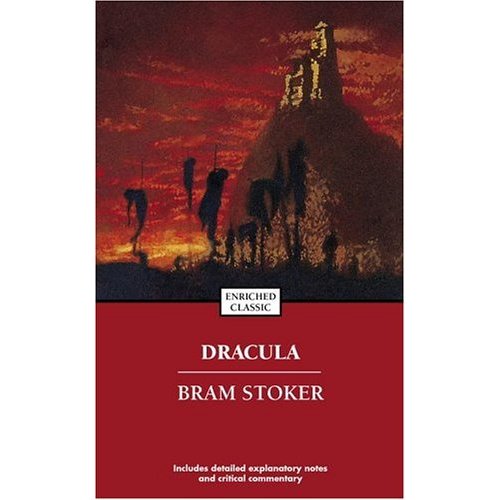
So I went back to what many might consider source material:Bram Stoker‘sDracula. He was not the first to cover this ancient ground (other well-known stories includePolidori‘sThe Vampyre, andLe Fanu‘sCarmilla), but he is very likely the most well-known and most-referenced author of vampire fiction. The copy I chose is theSimon & Schuster Enriched Classicsedition, with notes and commentary byJoseph Valente, a Professor of English.
[Though I enjoy books in which such additional information helps provide historical, social, political, or religious context, or discusses why something may have been important or overlooked by characters in the book, and so on, I sometimes wonder how much of the commentary is really just the commentator’s twisting of the text to fit an opinion, and how much is straight-forward observation of the material.]
Vampires and sex, an age-old coupling. The reasons are obvious: attacks that happen at night, usually on victims who are of the opposite gender to the vampires doing the attacking, and (inDraculathe novel) after the victims are in bed. And there’s the whole neck-biting schtick—which, as we all know, is more than a flirty little nibble.
There’s a lot of writing out there concerning vampirism and Victorian views of sexuality, and there’s a realm of scholarship that sees Dracula the character as freeing women sexually while Van Helsing, et al, try to suppress them. And, though the women seek help from their friends and send up prayers to God, they are drawn to the immortal count because their subconscious supposedly really, really wants him.
While such arguments might be made, there’s not much in the novel itself to support them. Yeah, vampires may work their mojo, but they’re presented as evil, and not all that sexy. Sensual, maybe, but not freeing. They’re rapists—even the females. After all, rape isn’t about sex or mutual expression or love. It’s about power and control.
Dracula controls Lucy. He controls Mina. Neither woman wants what he’s offering, and the men do what they can to stop him. Sure, they make some bonehead mistakes, like leaving Mina alone while they scout the count’s London digs, but I never get the impression they are trying to suppress either woman. In fact, Mina and Jonathan seem quite happy with their marriage. Until Dracula gets involved, of course.
—to be continued—
UPDATE: Last year, I read John Whalen’s excellent Western twist on vampires,Vampire Siege at Rio Muerto. You can read my review of his well-received novelhere.
Friday, I took a walk, a reward to myself for completing a freelance project, and a chance to be away from the computer and revel in the sunlight. (Aaaaaah! My eyes! My eyes!) When I returned home, however, I didn’t want to return to work. If there is an autumn equivalent of spring fever, I have it.
There’s not much story there, other than the old one: brain takes a walk while the body struggles to complete tasks by itself. Not very literary, eh?
How ’bout this: Little kids know a good story when they meet one.
A few days ago, four-year-old Sunny ran through the house, narrating as she went: “…and then there’s a tree…Oh, no! Watch out!…but Sky swoops in…”
She complicated her play by introducing obstacles and problems, but also enabled her pretend self and other characters to overcome those blocks by imbuing herself and her imaginary friends with creative skills or tools to deal with whatever occurred.
Last night, while re-watching a Korean television series that a friend had not yet seen, I saw specific points where — if the characters had been wiser, had been less ruled by fear or grief or anger or greed, had been quicker or stronger or less driven, the story would have ended much sooner than it does.
I was frustrated by the ugly motives that led to unnecessary tragedy, but acknowledged that — without them — the rest of the story would not only lose its power but its purpose. An intriguing, funny, poignant, suspenseful series would not exist.
To borrow from another post on this blog, stories are interesting because bad things happen.
Or, to borrow from the Chinese, “May you live in interesting times.” It’s a curse, not a blessing, the most interesting times being those with wars and natural disasters. Kinda the ancient Asian version of “Go to hell.”
I’m close to wrapping up edits on a client’s fictionalized autobiography…although I like this book, the ending is thin…
I headed downstairs this afternoon to fill my cup with fresh, hot tea, and that’s when I saw the problem: There’s a positive change in the lead character’s life, but there’s no transcendence.
Sure, the guy overcomes a crappy childhood, a weak and aimless youth, and a bout with addiction and alcoholism, and he’s definitely in a better place now, but–
What now?
And why did he finally decide that addiction was not the life for him?
Even in true-to-life stories, characters need a reason, a motive, and then action to back it up.
Otherwise, it’s not just the editor who’s falling asleep, but the audience is, too.
A horror story is playing out in the Middle East — not only there, but around the world — as adherents to a violent ideology behead, crucify, rape, torture, hang, beat, and exile anyone weaker or who doesn’t believe the same way or to the same extent as they. Similar atrocities have occurred throughout history, perpetrated by different groups in different places. Mankind conjures insane evil against itself and calls it good and justified.
And yet from this darkness arises life-changing, life-affirming stories.
One such is the recent travails of Miriam Ibrahim, a Sudanese woman accused of apostasy and adultery, and imprisoned in chains, because she married a Christian man, an American citizen. She even gave birth while in chains. She and her family were rescued and brought to the US in summer 2014.
Another such story can be read in The Hiding Place by Corrie ten Boom, which recently became a banned book in some libraries. It details how the ten Boom family hid Jews from the Nazis, how Corrie endured and survived a concentration camp, and how faith sustained her.
Powerful stories will be born of the current horror, as well. Tales will be told of pointless tragedy and humbling self-sacrifice, crushing dominance and inexplicable mercy, breath-stealing loss and unexpected gifts. Violence so vile it can scarce be imagined, let alone described, and yet compassion so kind one cannot help but weep.
Stories need something to overcome, and they need a reason to overcome it.
A candle is lost in the sunlight, but shines like a star in the dark.
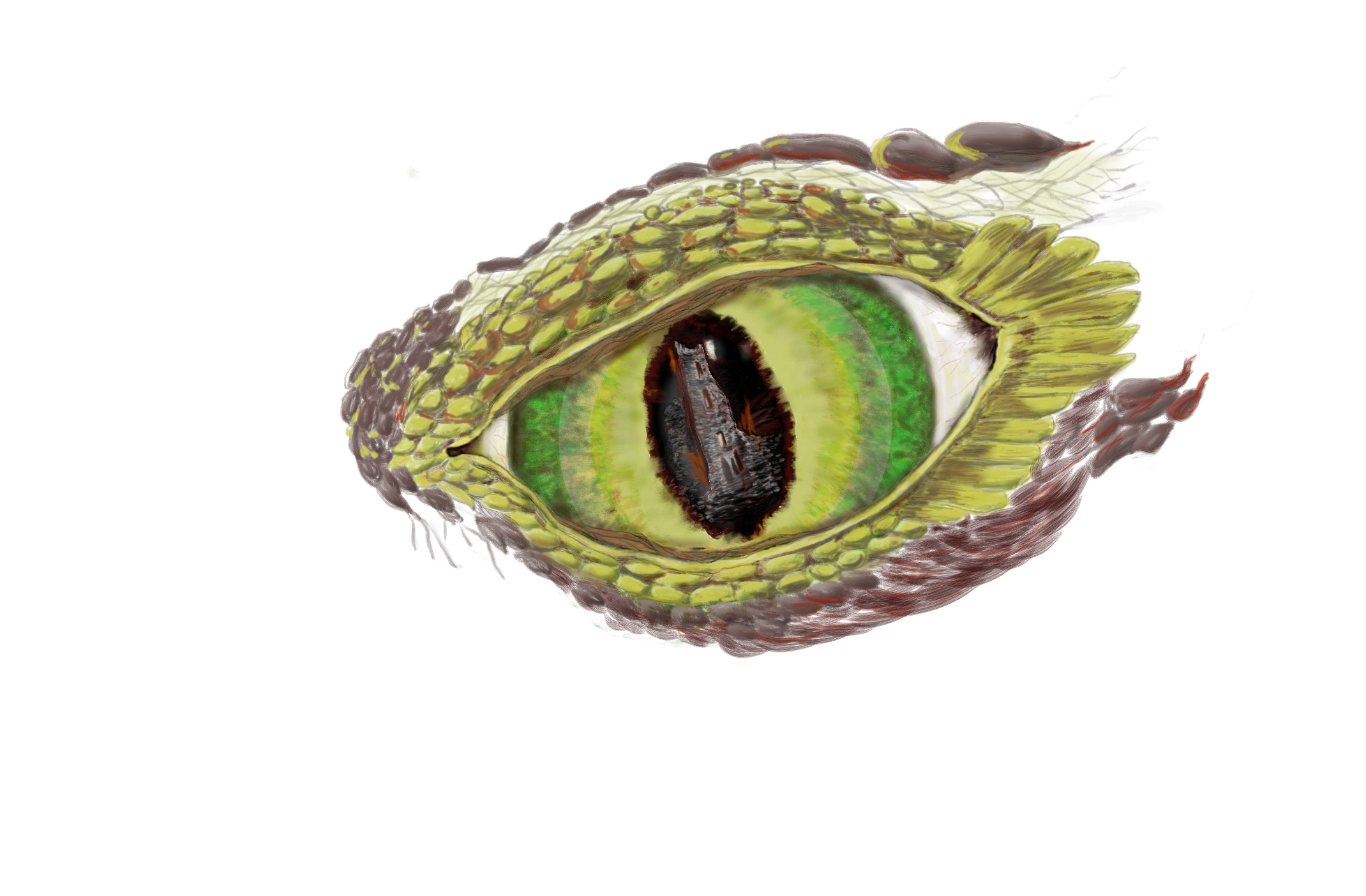
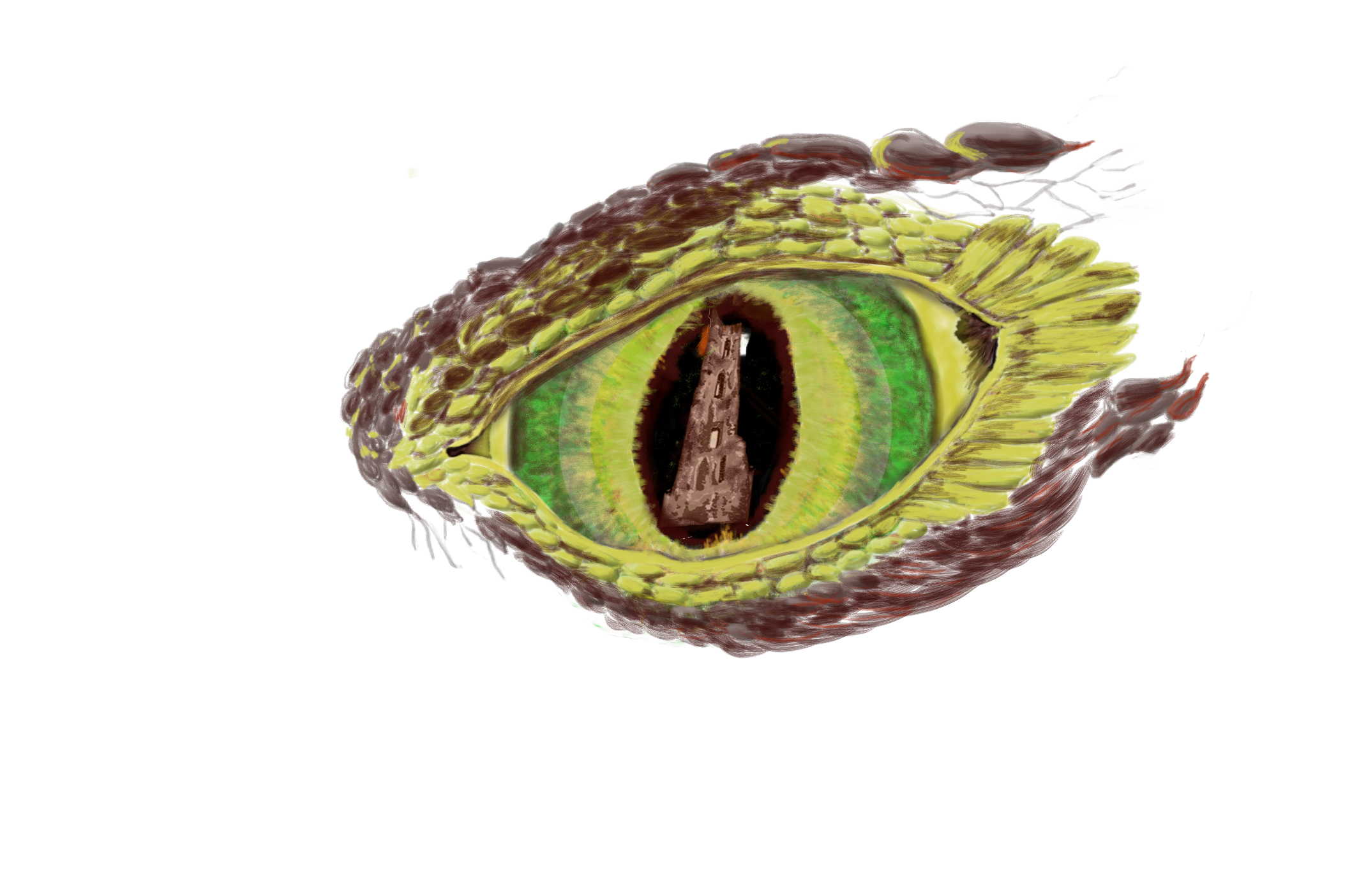
Thanks to input from a friend, I upgraded the cover art for Dragon’s Rook. The eye is looking down as the dragon swoops toward the tower. The castle tower itself is shaded in with more detail.
My friend and fellow author Keanan Brand is nearing the publication of his new fantasy novel, Dragon’s Rook. In June, I saw this post on his Adventures In Fiction blog: “Wanted: Cover Artist.”
When Keanan asked me if I’d draw the cover art for his book, I accepted the job and felt honored to be chosen for the work. As a child the public library was my playground of choice and I suspect that deep down it has always been my dream to be a cover artist!
But there was a problem. I was trying to break into the design world via my Bamboo tablet (a graduation gift). I’d already faced the challenge of learning to draw on a flat surface while looking at the laptop screen to see where my stylus was pointing. How I wished I had a tablet with a screen as I struggled to get my hand-eye coordination right! For an artist used to drawing on paper, it was certainly my first hurdle to overcome.
Practice improved my skills, and I felt ready to try a larger project.
The Original Vision:
Keanan’s vision for the cover of Dragon’s Rook was a detailed drawing–
“Art involving a dragon eye, a massive claw gripping a pile of rubble, one wing wrapping the side and bottom of a crumbling stone tower, and maybe shadowy shapes in the dark distance. A cover that will still look good as a thumbnail image.”
My Vision:
Though I searched online for images to inspire the work, I felt drawn to the idea of a circle in the middle of the book cover. A single dragon eye, like the picture Keanan had posted on his blog. We talked about it, and Keanan liked the idea. It almost seemed to pay homage to a hardbound book he recalled from the Lord of the Rings trilogy.
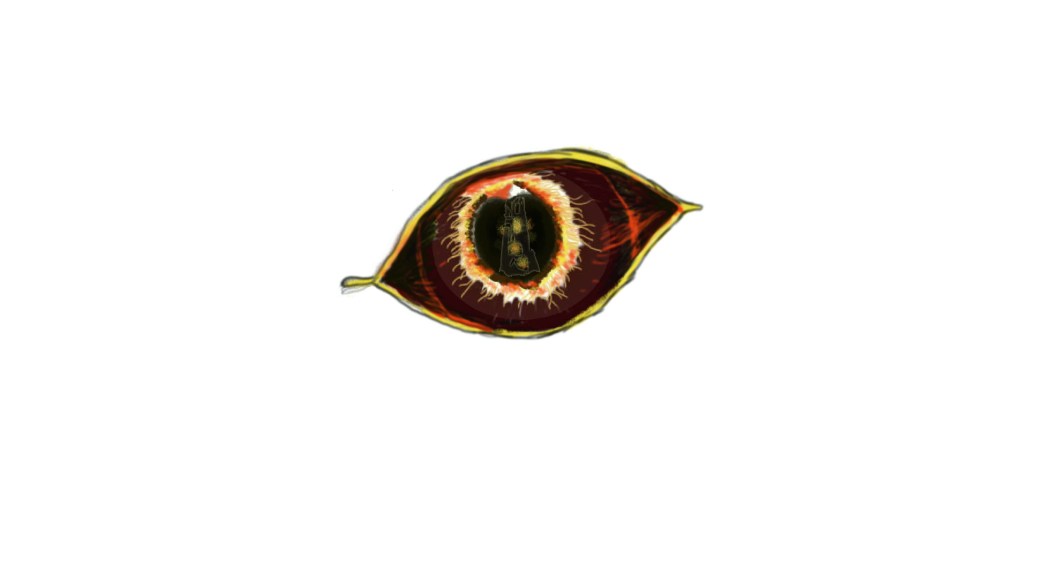
The Eye of Sauron. The eye of the Dragon King.
We decided that a castle tower would be reflected in the pupil.
A simple and thought-provoking image, telling a tale, inviting the reader to open the book. Or in this case to purchase it for their e-reader, since Dragon’s Rook will be published electronically first.
Evolving Images:
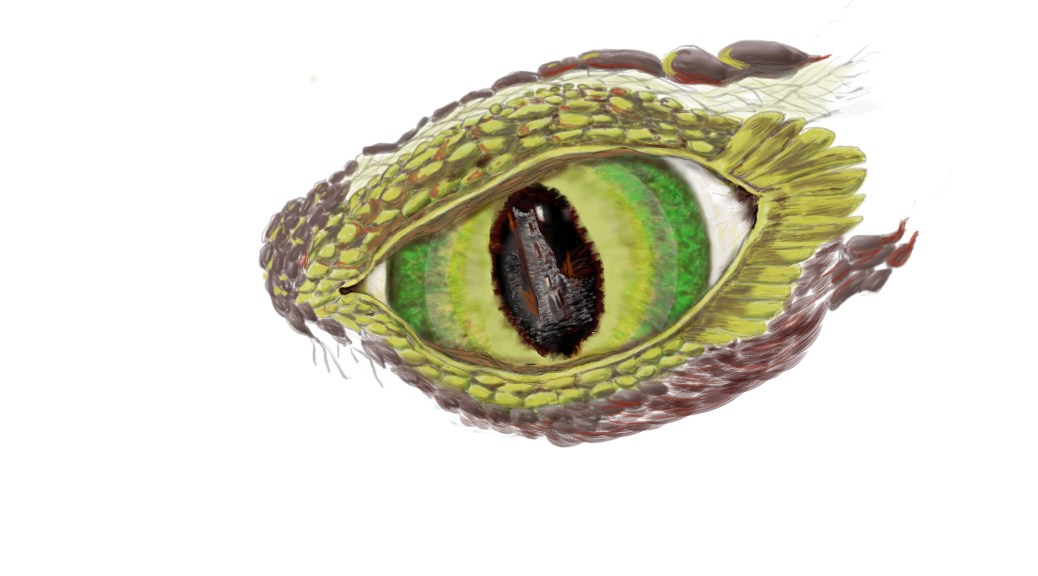
My initial offering was a rather menacing eye, but still not detailed enough to catch the reader’s attention as a thumbnail image. You can see this below.
I also had a few hiccups along the way, including one image that looked a little bit like an olive. “Dragon’s Cook?”
Finally the image began to look more like something we both felt was getting close to the vision.
I wanted to add smoke and fire, but felt it would complicate the image too much. Keanan suggested creating a white for the eye rather than using the yellow background for the iris. I also wanted to add wrinkles to indicate the creature’s age.
I decided to build up the scales with the bevel effect with the Bamboo oil and dry brush tools. The scales reminded me of cobblestones. The bevel effect made them pop with an almost 3D-style!
The details faded as the viewer got further from the center of the eye. Like a tornado, the swirling scales pulled a sharper focus toward what the dragon was viewing.
The Final Image in Progress:
We felt that our vision for the cover was simple, intriguing, and menacing!
Future Plans:
We plan to use a very similar style for the Dragon’s Bane cover. This is the next book in the series, and it will feature the eye of a different dragon character, with a sword instead of a castle tower in the iris of the eye. This image is not shown at full size, but should give a good idea of our design plans for the book.
Feedback on this design is greatly appreciated as we finalize the project!
-Suzan Troutt, artist and author, art copyright 2014-
My friend and fellow author Keanan Brand is nearing the publication of his new fantasy novel, Dragon’s Rook. In June, I saw this post on his Adventures In Fiction blog: “Wanted: Cover Artist.”
When Keanan asked me if I’d draw the cover art for his book, I accepted the job and felt honored to be chosen for the work. As a child the public library was my playground of choice and I suspect that deep down it has always been my dream to be a cover artist!
But there was a problem. I was trying to break into the design world via my Bamboo tablet (a graduation gift). I’d already faced the challenge of learning to draw on a flat surface while looking at the laptop screen to see where my stylus was pointing. How I wished I had a tablet with a screen as I struggled to get my hand-eye coordination right! For an artist used to drawing on paper, it was certainly my first hurdle to overcome.
Practice improved my skills, and I felt ready to try a larger project.
The Original Vision:
Keanan’s vision for the cover of Dragon’s Rook was a detailed drawing–
“Art involving a dragon eye, a massive claw gripping a pile of rubble, one wing wrapping the side and bottom of a crumbling stone tower, and maybe shadowy shapes in the dark distance. A cover that will still look good as a thumbnail image.”
My Vision:
Though I searched online for images to inspire the work, I felt drawn to the idea of a circle in the middle of the book cover. A single dragon eye, like the picture Keanan had posted on his blog. We talked about it, and Keanan liked the idea. It almost seemed to pay homage to a hardbound book he recalled from the Lord of the Rings trilogy.
The Eye of Sauron. The eye of the Dragon King.
We decided that a castle tower would be reflected in the pupil.
A simple and thought-provoking image, telling a tale, inviting the reader to open the book. Or in this case to purchase it for their e-reader, since Dragon’s Rook will be published electronically first.
Evolving Images:
My initial offering was a rather menacing eye, but still not detailed enough to catch the reader’s attention as a thumbnail image. You can see this below.
I also had a few hiccups along the way, including one image that looked a little bit like an olive. “Dragon’s Cook?”
Finally the image began to look more like something we both felt was getting close to the vision.
I wanted to add smoke and fire, but felt it would complicate the image too much. Keanan suggested creating a white for the eye rather than using the yellow background for the iris. I also wanted to add wrinkles to indicate the creature’s age.
I decided to build up the scales with the bevel effect with the Bamboo oil and dry brush tools. The scales reminded me of cobblestones. The bevel effect made them pop with an almost 3D-style!
The details faded as the viewer got further from the center of the eye. Like a tornado, the swirling scales pulled a sharper focus toward what the dragon was viewing.
The Final Image in Progress:
We felt that our vision for the cover was simple, intriguing, and menacing!
Future Plans:
We plan to use a very similar style for the Dragon’s Bane cover. This is the next book in the series, and it will feature the eye of a different dragon character, with a sword instead of a castle tower in the iris of the eye. This image is not shown at full size, but should give a good idea of our design plans for the book.
Feedback on this design is greatly appreciated as we finalize the project!
-Suzan Troutt, artist and author, art copyright 2014-
My first choice for book cover artist isn’t available after all, and I’m in need of art involving a dragon eye, a massive claw gripping a pile of rubble, one wing wrapping the side and bottom of a crumbling stone tower, and maybe shadowy shapes in the dark distance. A cover that will still look good as a thumbnail image.
No fancy streamers on this dragon, or fur or horns, but make him streamlined and muscular. Defined eye ridge. Cat-like rather than human-looking pupil. Think ginormous Komodo dragon with a large wingspan and a long neck and tail. Legs maybe a person-and-a-half tall. Gold scales, green eyes.
Full disclosure: I can’t pay much right now, but I want to be fair, and may be able to add a bonus after the book sells. I’m interested in your best work. The fantasy novel — Dragon’s Rook — will be released as an e-book first, and then in print. You will receive full credit for your work (on the copyright page and/or in the acknowledgements), and I will be happy to include your contact information, as well (website, e-mail, etc.). Thanks!
To the description should be added these necessary details: broader head or snout than a Komodo, and huge eyes. None of these beady little things that are easily dismissed, but mysterious, arresting eyes that could mesmerize anyone looking into them. If that’s not possible with a cat-like pupil/iris, then use a human-like eye shape.
If this sounds like a project you’d be interested in joining, please leave a reply to this post.
I’m interested in seeing various styles of art, and whichever is chosen for Dragon’s Rook will have the first crack at the cover for the second book, titled either Dragon’s Bane or Dragon’s Blood.
In Part 1 of “Telling Our Stories”, an adaptation of a presentation given to a female group of non-writers, I discussed editing, faith, and how and why God is a storyteller. In this half, I discuss why we need to tell our stories, and then I’ll share a bit of my own.
My favorite Bible stories teach and encourage me:
Queen Esther
Mary, the mother of Jesus
Ruth
Elizabeth, her wise cousin
David and Goliath
the Resurrection
Elijah and Elisha
the Acts of the Apostles
and many, many more.
Jesus told parables involving women (the lost coin, the ten virgins), and there are several stories in the Gospels of His interaction with women:
woman taken in adultery
Jairus’ daughter
woman at the well
Peter’s mother-in-law
woman with the issue of blood
Mary at the wedding in Cana
the Syro-Phoenician woman
the women among His followers
The Old Testament is also full of strong female role-models: Esther and Ruth, of course, as well as Deborah the judge and Rahab who—even though she was a prostitute—came to trust God and was an ancestor of Jesus. The stories of Abigail and other women not only captured my imagination, but planted truths in my soul that helped me grow in my faith, even as a child.
3
God invites us to be storytellers.
Let the redeemed of the Lord say so,
Whom He has redeemed from the hand of the enemy
Psalm 107:2 (NKJV)
Let the redeemed of the Lord tell their story—
those he redeemed from the hand of the foe
Psalm 107:2 (NIV)
Hear, O Israel: The Lord our God, the Lord is one! 5 You shall love the Lord your God with all your heart, with all your soul, and with all your strength. And these words which I command you today shall be in your heart. You shall teach them diligently to your children, and shall talk of them when you sit in your house, when you walk by the way, when you lie down, and when you rise up. Deuteronomy 6:4-6 (NKJV)
But you must continue in the things which you have learned and been assured of, knowing from whom you have learned them, 15 and that from childhood you have known the Holy Scriptures, which are able to make you wise for salvation through faith which is in Christ Jesus. 2 Timothy 3:14-15 (NKJV)
So, why don’t we share our stories?
Pride? Fear? Distrust?
Perhaps we think people will judge us or won’t care.
Maybe we don’t know that our stories matter.
Maybe our stories are difficult—not just difficult to hear, but difficult to tell.
If so, here’s a secret:
Stories are only interesting if something bad happens.
If the hero never faces a challenge, never has an obstacle to overcome or an enemy to defeat, what’s the point? If Goliath was a wimpy little fella, why tell the story?
If it were a movie, people would fall asleep in the theater. If a book, it would never be read.
I’m not saying we should be happy when trouble enters our lives, but we can recognize it for what it is: another twist in the plot, another event in the story of our lives.
Yaquina Bay Bridge, Newport, Oregon (c2013, KB)
We’ll tell others about it later—how we faced down death, came back from the brink of financial disaster, survived homelessness or alcoholism or physical abuse. Stories are bridges between hopelessness and purpose, failure and perseverance, darkness and light.
Therefore, having been justified by faith, we have peace with God through our Lord Jesus Christ, through whom also we have access by faith into this grace in which we stand, and rejoice in hope of the glory of God. And not only that, but we also glory in tribulations, knowing that tribulation produces perseverance; and perseverance, character; and character, hope. Now hope does not disappoint, because the love of God has been poured out in our hearts by the Holy Spirit who was given to us. Romans 5:1-5 (NKJV)
THAT’s why we tell our story.
4
I always wanted to be brave, but knew I was a coward.
I loved to read stories of heroes from history, heroes of the faith, everyday people who were strong and stood for what was right.
However, I wouldn’t tell the truth when I should, out of fear of the consequences.
In childhood and even into my twenties, I attended churches with intensely evangelistic environments that could be compared to high-pressure sales: no one was getting away without hearing our pitch.
I hid from that by—ironically enough—carrying my Bible on top of all my schoolbooks, hoping other kids would ask me about it without me having to approach them first.
I’d stand up for my friends, but mock my faith, my overweight appearance, my bookish ways, and I’d back down and hide.
At age four, a huge fear entered my life, and with it came nightmares.
In the early 70s, my cousin DJ and I witnessed a fatal accident while playing in our grandparents’ front yard. We’d wanted to play in the ditch, but the grownups wouldn’t let us because 1) it was muddy, and 2) it was outside the fence.
We heard a screeching crash, and looked up to see what looked like one car with two back ends. A drunk driver in a Thunderbird had rounded the corner and veered into the inside lane, crashing head-on into a family’s station wagon.
He was thrown into a blackberry bramble on the far side of the road, and survived with only scratches and a broken collar bone. As I recall, only the father and one child survived in the station wagon.
In the confusion to help the victims, someone handed me a blanket, and I did what everyone else was doing, and toddled out to the ditch so I could give one of the rescuers a blanket. Recall, I was only four, and this was before the days of 911 and rescue vehicles being coordinated in their response times.
I reached the ditch, and saw my father straddling a body with no face. Whenever he would push down on the chest, air bubbles formed in the blood where the face should have been. I held out the blanket. He reached for it, and then he realized who was standing there. He yelled at me to get away, and I thought he was angry with me. Only later did I understand he was trying to protect me.
From that day onward, I had a fear of accidents, of wearing my seatbelt or not wearing it, of being cut by glass or being thrown out the window or hitting face-first against the seat in front of me. Riding in cars was stressful for a good long while.
Much later, in late teens and early twenties, I lived in a long dark tunnel of depression. The first time, I was suicidal. The second depression was shorter, I recognized it for what it was, and came out of it stronger than before.
I’ve survived automobile accidents, workplace bullies, foolish choices, church gossip, and even my own family.
Shortly before my twelfth birthday, my maternal grandfather and my uncle resorted to violence to settle a problem so minor it could have been resolved with a conversation. It didn’t even bear mentioning.
And yet they held a knife to my eight-year-old brother’s throat, and guns to our heads.
They threatened to kill our parents if anyone came to get us. They disowned my mother, and said many other things best forgotten. Peace I cannot describe came over me, and I knew God was in charge. We were going to come out of there alive.
There’s more to that story, but I’ll tell you later.
In my twenties, a suicidal woman named Carol pointed a gun at me and my friend, intending to kill us and then herself. I didn’t move, didn’t speak, but just continued leaning against the window A/C unit and sent up a silent prayer. I didn’t know what else to do. Again, I was strangely calm in that moment. I was ready to die.
Carol put down her gun and wept. Many nights later, she was drunk and met me in the church parking lot, but wouldn’t look me in the eyes. She said the reason she couldn’t pull the trigger the first night, and why she couldn’t look at me now, was because of the person she saw with me, the person looking out of my eyes. Not me. Someone else was looking at her. She wanted the love she saw, but felt unworthy of it. Could I help her?
In my thirties, I hit an icy patch on the road and rolled my truck. The man who helped me get out expected to find a dead body. Instead, I blacked out only briefly. Although I had a concussion and strained muscles, I was cognizant and fully able to move.
When I look back on the events of my life—the miracles, the healings, the long troubles that seemed never to end—I can see the story God has been telling.
But only when I look back. It’s hard in the moment to see the story.
5
Why Stories?
Stories are powerful.
They convey truth often better than a lecture, an advice column, or even a sermon.
And how are sermons illustrated? By scriptures and by stories.
Jesus used stories to point to the kingdom of heaven, to show people how to live, to show how much God loves us. However, to do so, He also showed us ourselves in our imperfections. In the parables of Jesus, people make mistakes or wrong decisions:
a rebellious son squanders his inheritance
a man forgiven his debt refuses to forgive someone else
bridesmaids arrive unprepared
wedding guests refuse to accept a generous invitation
For centuries, histories were kept alive by storytelling. Now we write history in books.
Strong stories often contain Biblical truths or concepts,
although they may not outright preach them.
I reiterate, stories are powerful.
People who might never pick up a Bible will pick up a novel.
Stories can reveal truth in ways that will capture the minds and hearts of readers who otherwise might never come into a church to hear the sermons.
In Him was life, and the life was the light of men. 5 And the light shines in the darkness, and the darkness did not [overcome] it. John 1:4-5 (NKJV)
Stories spark the imagination.
They ask questions and rouse curiosity. They engage the mind.
Remember the disciples asking Jesus what His parables meant? The disciples were interacting with the stories. They were engaged.
Stories are why novels, role-playing games, stage plays, television shows, and movies are so influential in our culture.
Click the book cover to read a sample chapter
To further answer the question, “Why stories?” read Dan Allender’s excellent book, To Be Told. In it, he shows how God uses our stories to guide, heal, and direct us, and to help us minster to others.
6
Remember when I said there was more to the story involving my grandparents and my uncle?
The police took my brother and me away from the house in the wee hours of the morning. The grownups said everything was my fault.
My parents considered pressing charges, or at least getting a restraining order, but because of what my grandparents and uncle told the police, I was afraid they would lie in court. I didn’t want to have anything to do with them. I just wanted everything to quiet down and be normal again.
About a year or so later, my grandparents announced that my grandfather’s heart was failing, and begged to come see us. I tried to be cool about it, but I couldn’t wait for them to leave.
A couple years after that, near Thanksgiving, my grandfather died. Mom mourned him, but I couldn’t understand. Yeah, he was her father, but he’d been abusive to her, and he’d tried to kill me and my brother. I was relieved he was dead.
This August, nearly thirty years later, Mom and I traveled out west to see my grandmother and uncle. I didn’t want to, but I knew it mattered to Mom, and we’d had a trip to the West Coast planned for several years.
I’d forgiven my grandmother and uncle a long, long time ago. Yet, rather than accept the responsibility for their actions, they continued to blame me.
But when we walked into the rehab center, Grandma was sitting in her wheelchair near the door, and the first thing she said to me, tears running down her face, was “I’m sorry. I’m so sorry.” No blame, no lies, just repentance.
Life is messy.
It’s also full of blessing.
Life is hard, but God is good.
And that’s my story.
Think about the word destroy. Do you know what it is? De-story. Destroy. Destory. You see. And restore. That’s re-story. Do you know that only two things have been proven to help survivors of the Holocaust? Massage is one. Telling their story is another. Being touched and touching. Telling your story is touching. It sets you free. ― Francesca Lia Block
I know the truth of these words. Oh, the stories I could tell! And you—what is your story?
Our stories must be told. Not necessarily the fiction, the things we imagine, but the truth, the things that happened to us, the things we did.
Below is the first in a series of blog posts addressing the need to tell those stories. It was originally conceived as a presentation to a group of non-writers, then was abridged as a talk to a small Bible study group.
Although I originally addressed Christians, much of the material applies to fellow writers and to people in all walks of life, especially those who have dealt with tragedies, abuses, things they can’t find the words or even the will to reveal to others. Perhaps something written here will inspire them to open their mouths or take up their pens and tell their stories.
1
Since we came to know Christ, storytelling has been—or should be—a natural part of our lives. When we minister to others, when we give an answer for the hope that is in us (1 Peter 3:15-16), we have opportunity to tell our stories of what God has done for us.
I’ll begin by discussing my work as an editor, segue into the importance of storytelling in the Bible, and then how we are storytellers in our everyday lives.
As an editor, my job is to help authors shape and correct their work.
It’s not my job to write the story for them, but to help them present their best work.
Sometimes our journey seems to be all uphill, arduous and never-ending. Writing and editing can be the same. They don’t have to be. We’re not responsible for the condition of the road, but our attitude determines the quality of the trip. (c2013, KB)
Whether they’re freelance clients or authors under contract with a publisher, the most difficult writers to work with are those who don’t see their need for change. They don’t think they need to improve anything. They’ve fallen into the trap of pride.
They just want someone to tell them how good they are, to approve of whatever they write, and to require nothing else from them—not revising, no researching, nothing but collecting the royalty checks.
Problem is, if there’s not a quality product for sale, then those royalty checks will be rather thin.
We’re all imperfect humans. We all have room for improvement.
Even editors are not infallible or all-powerful. There comes a point when I have to step back and let the writer have his way. After all, it’s not my story. I’ll lead, I’ll guide, but I won’t write the book.
My favorite writers to work with are those who are humble and teachable. They don’t have false humility, an insidious form of pride. They know they have a good story. They know they can write, but they’re always striving to be better, to improve their craft.
They want to present their best work to the world. If they’re Christians, they also want to glorify God above all else.
Whether therefore ye eat, or drink, or whatsoever ye do, do all to the glory of God
I Corinthians 10:31 (KJV)
Before I can begin editing a manuscript, there must first be words on the page.
Sometimes, writers can’t create because they’re too concerned with perfection. The story doesn’t arrive fully formed, with the characters alive, the sentences in the correct order, the words flowing with a beautiful cadence—and so the writer stalls.
The process isn’t neat and orderly. It’s messy and requires hard work. Therefore, the writer is blocked. He can’t move forward. He spends his time perfecting the words he’s already written, polishing them until they shine, but he writes little or nothing new.
How many of us are like that writer?
How many of us aren’t really living forward? We spend our time looking backward at the past. We play the what-if game, the if-only game, but don’t expand our horizons or accept new challenges, because doing so is hard—especially when we fail.
Some view failure as the end. Some view it as only the beginning—a lesson learned on the way to a greater goal.
Some writers lose contest after contest before they win anything. Some send out manuscripts over and over only to be rejected time and time again before someone sees the potential in the story and publishes it. Those writers never give up despite failure. They have a greater goal in mind, and they are perfecting their writing each time they write a new story or revise an old one.
Do we defeat ourselves before we even begin?
How can God shape our stories when we give Him so little to work with?
Take movies, for example.
The version we see in theaters is the theatrical release.
Some movies have another version—the director’s cut.
The director’s vision for the film may differ greatly from what is seen in theaters. It may have more scenes or even alternate scenes, and contain details that expand or enhance the story. Therefore, it is usually longer than the theatrical release.
In our everyday lives, how many of us only want the theatrical release?
We want to skip to the good parts, the interesting and action-packed parts, and forget the rest—the boring everyday stuff, the sad or tragic scenes?
But life is the director’s cut, and we have to live every moment of it.
2
God is a storyteller.
The first book every printed on a press, His has outsold all others.
The Bible is full of stories. Jesus used them to illustrate the Gospel. Recall this phrase: “The kingdom of heaven is like…”? It precedes several of His parables, a sacred “once upon a time”.
Why did He tell these stories?
That We May Believe
And truly Jesus did many other signs in the presence of His disciples, which are not written in this book; but these are written that you may believe that Jesus is the Christ, the Son of God, and that believing you may have life in His name.
John 20:30-31 (New King James Version)
And there are also many other things that Jesus did, which if they were written one by one, I suppose that even the world itself could not contain the books that would be written. Amen.
John 21:25 (NKJV)








 Penworthy Press