Tag Archives: Writing Advice

Moment of Truth

Everyone stresses. Even those of us who meditate or pray, or try to set aside burdens that are not our own and let others take responsibility for their own actions — we all stress about something.

One person’s concern is not necessarily another’s. What angers one may make another laugh. What makes one cry may make another contemplative.

I try to be balanced in thinking and reacting to whatever life hands me, but have been known to let my train go screaming spectacularly off the rails over the stupidest things.

There’s no train wreck now, but a quiet, intense waiting. Earlier this week, I told the truth that had been roiling inside me and expressed to everyone but the two people who needed to hear it the most. For months, I wrestled with this truth — let resentment build, and anger. I worried that I might be wounding a tender young ego (the author’s), or might invite the wrath of an older but still tender ego (a founding editor’s).

So, instead of speaking truth, I stressed. I ranted. I grit my teeth and got to work, knowing that all these hours of labor might very likely be in vain when the egos refused to admit the same truth: the manuscript is weak, full of holes, and displays a lack of insight, knowledge, and life experience that can only come with maturity and hard work and a few knocks from the mere act of living.

But I, as the editor, am supposed to fix all that and make the novel worthy of publication.

I remember being a young teen author, maybe thirteen, maybe only twelve, when a novel-in-progress was critiqued by a local author. At the time, I didn’t appreciate her effort and time and wisdom. All I saw was the stuff she didn’t like, the flaws and the corrections. I didn’t absorb the truth. Not for many years, sometime in adulthood.

Then, finding her notes one day while looking for something else, I read again those words printed in pixelated font on yellowing paper. She thought I was a good and imaginative writer. She liked the story. It’s good; now, here are a few ways to make it better. If she didn’t think it or I were worth the time, she wouldn’t have written such a long critique.

In that moment of realization and shame, I wanted to thank her, but surely she’s long passed, and I don’t even recall her name.

So, decades later, I am hoping my own honest critique, written in the spirit of encouraging the author while still telling the truth, will be received in the way I intend.

Worry is fear, and I don’t want to be ruled by fear: fear of what others may think, say, or do; fear of a future that hasn’t arrived. Come what may, truth has been told. Stress is gone.

Fun With Research

waiting for Morning Court to begin (Beltane 2013) c EE
waiting for Morning Court to begin (Beltane 2013)                                 c EE

A few weeks ago, I went on a research binge for a couple of novels — one complete, one in the works — and in the process sent out a lot of e-mail asking for help. I was amazed at how many people were willing and eager to answer questions and provide leads to other experts. I was equally surprised by those who were standoffish and almost suspicious.

I haven’t contacted the nearby police department yet — there’s time enough for that —  but efforts to speak to any of several local paranormal investigation teams were in vain. Nary a reply. Maybe they’re afraid of being mocked by a skeptic or an unbeliever. Maybe they have no time for someone not in need of their services. Maybe they’ve given up the gig, and all their contact information is obsolete.  (Given up the ghost? Ahem-ahem-ahem)

A few hours spent with writers at the OWFI conference, however, yielded an investigator who answered my questions with far more information than I expected, and in the process gave me new ideas for a scene involving teenage ghost hunters.

He did mention that I could pay for a training session, and participate in an actual investigation, but those are for true believers. Although it might help my research, it’s not my scene.

c2013, EE
c2013, EE
c2013, EE
c2013, EE

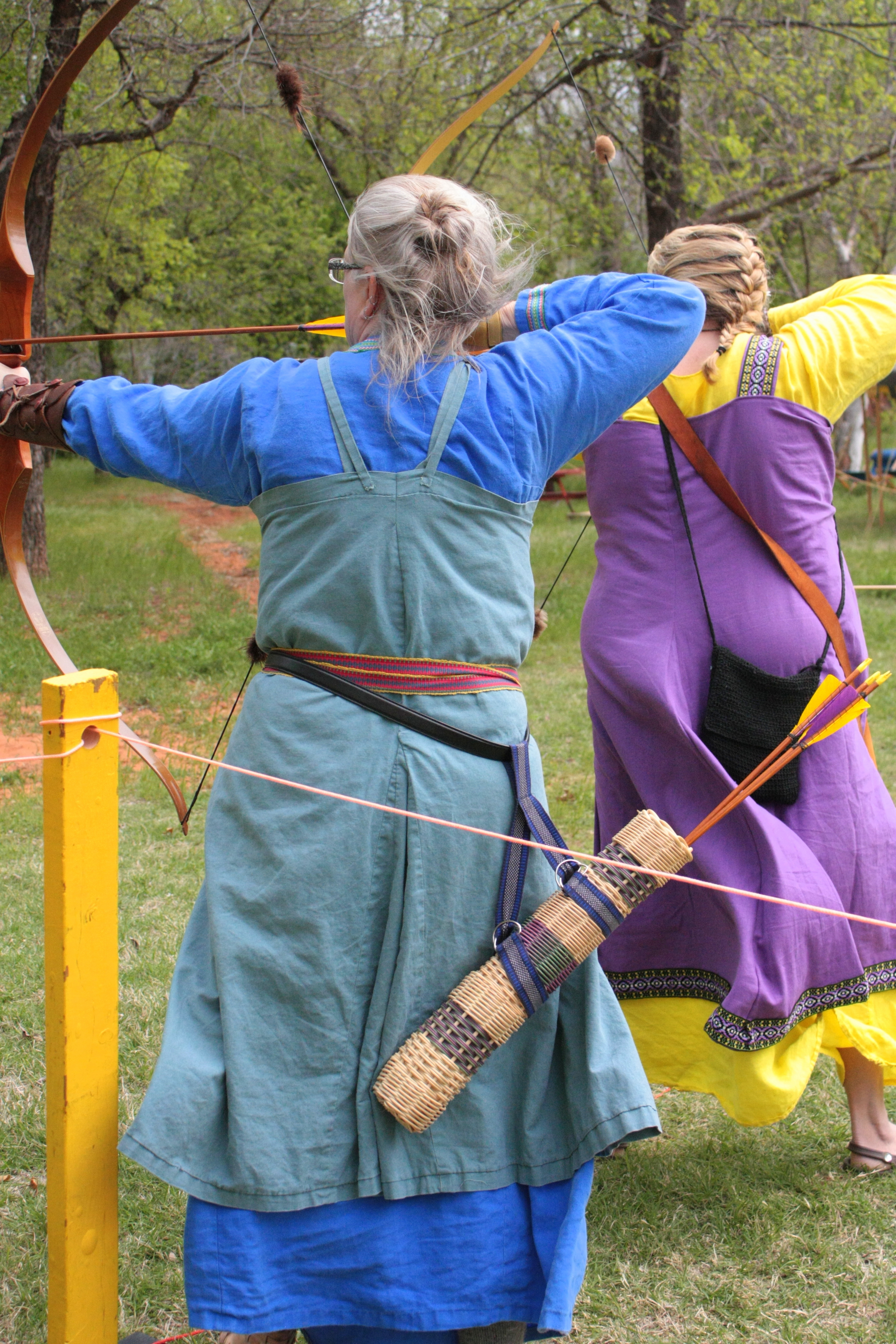
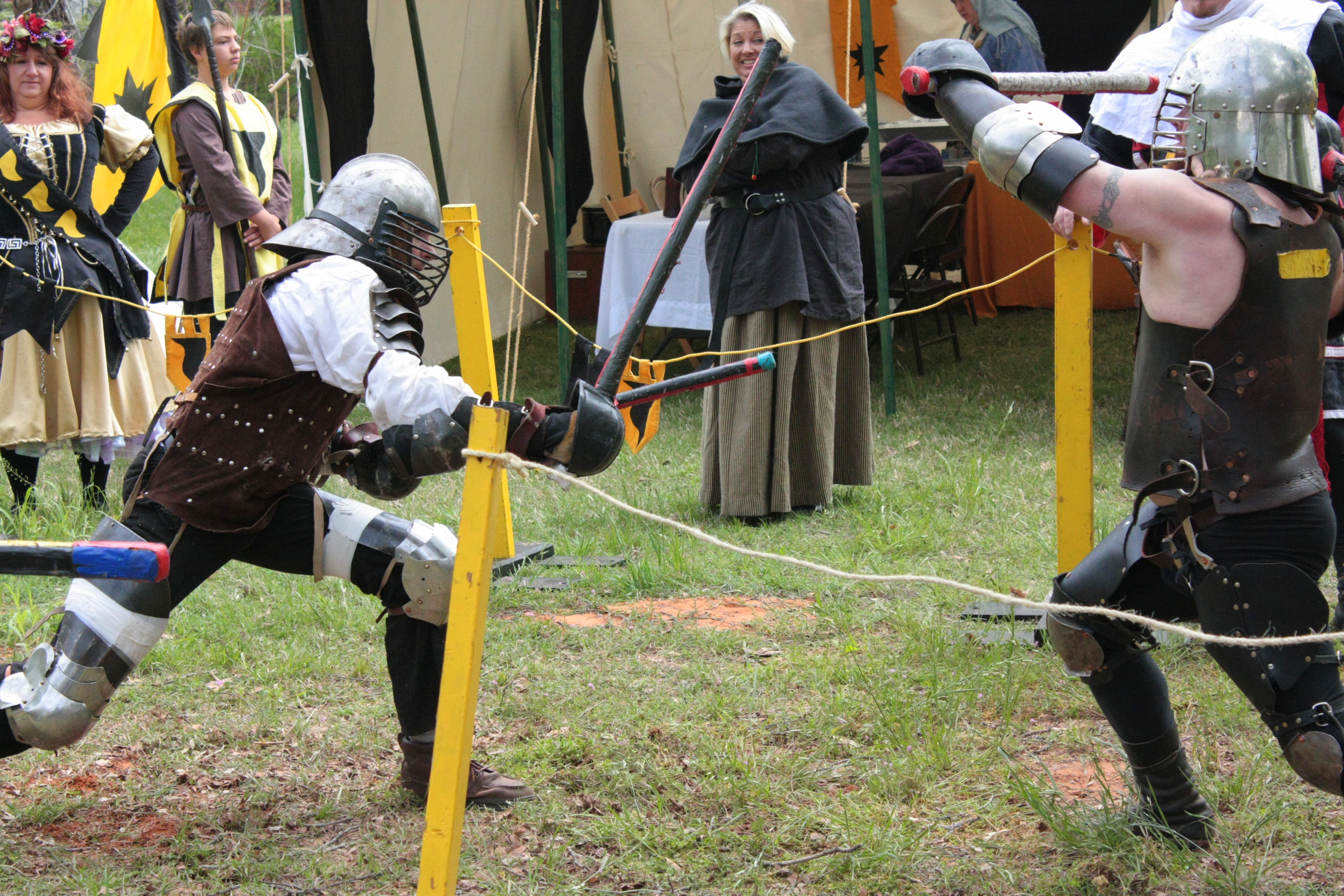
More in line with my interests, and one group that welcomed me, is the Barony of Namron, part of the SCA (Society for Creative Anachronism). They invited me to their annual Beltane event (a far milder and less pagan May Day than some). But rituals and pagan practices were not my focus, but smithing and all manner of crafts and weapons. No swordsmith that day, but a blacksmith named Simon, an archer named Lawrence, a few other craftsmen and warrior types, including female archers in Viking garb, and a whole lot of friendly folk willing to share their knowledge (and, in some case, volunteer other people as resources, but no one seemed to mind my nosiness).

There’s still much to ask, but first I have to know which are the right questions. Although I learned that I set up the smithy correctly in the novel, my blacksmith is limited in his knowledge due to my own ignorance.

He doesn’t have to know everything, because the story isn’t about the everyday life of a blacksmith — he just needs to be convincing and not sound or behave like an idiot. And, thanks to Simon, he won’t.

I hope.

After all, no matter how excellent the information, if I don’t use it correctly, my characters will suffer.

One solution is to be somewhat familiar with the topic before conducting interviews or gathering specifics. For instance, when I said I’m a writer doing research in order to make a fantasy novel more realistic in its details, people assumed knights and castles and tournaments and such.

c2013, EE
c2013, EE

Nope. The fantasy novels are set in an earlier era than that of plate armor and heraldry. Still, it was fun to watch the combat.

Other topics to research further: archery terms and equipment, chain mail, swords (their making and their use), cooking, leather-working, and clothing.

No one looked sideways at me during the SCA event. Fellow geeks and all.

But what’ll they say at the police department when I start asking questions about homicides?

The Poo Hitteth the Fan

I love books. However, due to being an editor, when I read for pleasure and not work, I don’t necessarily finish every book I attempt. Call me jaded. I won’t argue.

When I was younger, my mother scolded me for having too many novels stacked by the bed, bookmarks sticking out, because she said I started more projects than I finished. That was a valid concern. But I was voracious and not very discriminating: If a book was even remotely interesting, it was read. Or, at the very least, it was skimmed for the good parts.

Recently, I posted a review of a novel that shall remain nameless. It isn’t a glowing review, as many of them are, yet despite being in the minority, it isn’t the only review to point out a glaring fact: Although the artwork and premise of the book are good, the writing is not.

I don’t make a habit of posting negative reviews, and I generally have to feel strongly one way or the other (positively or negatively) before reviewing anything. In this instance, I really wanted to like this book. It had been talked up and marketed, and the artwork is fantastic, so I opened up the book in anticipation of a great ride.

Disillusion in the first paragraph.

But I kept going.

As the pages piled up, so did my disappointment.

I would have let the matter lie, and just walked away in search of something else to read, but this particular author and his enthusiasts acknowledge and even defend the poor writing while extolling the virtues of the overall story. After all, they say, many bestsellers aren’t necessarily written well (Twilight and Harry Potter have been cited to me several times, as if they are the standard).

There was a time, years ago in my wide-eyed youth, when I might have joined their parade, and berated any ol’ jaded editor for being hung up on the sentences and missing the big picture.

Now, though, after years on the other side of the writing and publishing biz, I thoroughly understand the need for the writer to take pride in his own work first. After all, if he doesn’t, why should anyone else? Why should an editor fix all his mistakes?

“Yes, but that’s your job,” you say.

Agreed. An editor’s purpose is to help a writer shape and polish his work.

It is not my job to pat him on the head and let him get away with crappy writing just because his noggin is chock-full of cool ideas.

Below are excerpts from my original review, as well as a brief exchange with one of the author’s fans who is not pleased with what I wrote. (Excerpts, because the original exchange is rather long.)

Me:

The artwork is fantastic, and this book appears to have an enthusiastic audience, which bodes well for the author’s future…The story may very well have been as intriguing as all the glowing reviews indicate, but I could not get past the awkwardness/clunkiness of the writing.

Someone else who also attempted reading the book wasn’t bothered by the writing so much as by the execution of the story. When I pressed for more details, this person just handed back the book and said she lost interest after the first few chapters.

Disgruntled Fan:

You are an editor… your job is to find problems with books. Some of the most poorly written novels sell in the millions (Twilight, Harry Potter). This is because the masses are not editors but normal people who enjoy a good story. As someone who works for a competing publisher the ethical move would be to remove this review.

Me:

As for the argument that poorly-written novels are often bestsellers, I have no argument there. They are.

However, it’s not in me to lie about writing quality — to simply go along to get along, because, hey, everyone else seems to like it, so I should just shut up. No, this is my craft, and it matters to me…So when I expect excellence from fellow writers, that’s not unethical or negative. It’s simply a matter of course. After all, I’d much rather walk over the bridge built by the meticulous craftsman than walk over the one constructed by someone content with “good enough”.

Disgruntled Fan:

And as to your craft, is it only to give negative criticism? I was not aware that this was an editor’s job. Is it so hard to find redeeming qualities in a book (granted you only read two pages) when I see a multitude of people making a laundry list of redeeming qualities…(W)hat I read is “Your writing sucks; how did you get published? This was a mistake. Don’t quit your day job.” There was nothing positive and you made it sound like the worst book in the world. I do not want him to quite writing, I loved the story. You mention a bridge that is good enough… But that isn’t what you said. You didn’t say that his novel was good enough. You said that the dung was so rank that you had to walk away before vomiting. (comments truncated due to being more of the same)

Me:

I never said I quit reading after page two (“the first few pages”), nor did I tell the author to quit writing. As a teacher, I would never tell someone to quit writing. And you’re the one who mentioned dung and vomit — not I.

You also seem to be saying that, since I’m an editor, I have no right to an opinion regarding any book, nor should I post a review unless it’s positive. To the contrary, only saying positive things would be unethical, because I wouldn’t be completely honest…I can appreciate a person’s creativity and effort without enjoying how those efforts and creativity are employed.

…I never attacked his creativity or his ability to conjure up intriguing stories. In your first comment, you stated, “Some of the most poorly written novels… .” Seems you already know that the author, while creative in his storytelling, could have spent more time on the way he presented his story. And that, (dear reader), is my original review in a nutshell.

Proverbs 26:4 comes to mind: “Don’t answer the foolish arguments of fools, or you will become as foolish as they are” (The Bible, New Living Translation).

Just as I don’t often post negative reviews, I don’t often become mired in online debates. I’m not one who enjoys arguing or conflict. What would you have done? Would you have posted any review at all? Would you have let Disgruntled Fan have his/her say, and remained silent?

Perspective and Storytelling

No, I’m not going to dive into a point-of-view lecture (I’ve done that too many times, and have borrowed from the lectures of others).

Yes, point of view is eminently important in shaping a story, lending it tone, flavor, expression.

What about perspective? How does the mountain look from your hero’s point of view? From the villain’s? From the guy on the street’s? From the guy who lives in a yurt at the top?

EE, a walk at sunset in April, c2013

This photo makes the water tower appear small and the tiny barbecue grill seem greater.

We know that’s just a trick of the eye, made so by where we stand.

How do your characters view their world?

How do those perspectives conflict, mesh, create new perspectives?

How do those perspectives affect the story?

Found Stories

c2011, EE
c2011, EE

When I (briefly) wrote freelance human-interest stories for a small newspaper, my focus was on “found” stories: not major events, not orchestrated photo opportunities, but the everyday lives or histories of people in the community. If a story crossed my path, I followed it:  welcoming home a deployed spouse; surprising parents with a new house; caring for an indomitable adult son stricken with multiple sclerosis; hosting bluegrass and gospel jams each weekend at an old schoolhouse; reuniting with classmates fifty years after they scattered to serve in World War II.

Photography is much the same: whatever strikes my fancy will be captured by the camera. The photo here is from 2011, taken at sunset on my way home along a backroad. Wildflowers (weeds) in a ditch caught my eye, so I stopped and spent a several minutes shooting them. Most were discarded, but I liked the bit of whimsy here.

I also like pieces of history, such as this cabin, photographed several weeks before the clover.

c2011, EE
c2011, EE

Nearby is an old schoolhouse, a courthouse and jail constructed of stone, an old Army tank, a weathered barn, and a memorial to coalminers.

Something about the cabin, though, invites photographs.

A couple months later, a friend and I went on a writing-and-photography retreat for a weekend, and took a few shots of a town that clings to the mountains, full of history but now crowded with tourists, and overshadowed by social politics. Still, it remains a place full of photography opportunities.

c2011, EE
c2011, EE

We’ve been there many times on our own, I for writing conferences and history, she for exploring haunted places, but this time we decided to attempt a writing project together. After all, one of my favorite mystery series is written by a mother-son team; surely a couple of old friends who write all the time could collaborate on a novel, right?

Weeeellll, we attempted it, wrote a few pages and outline notes, and that’s as far as it went. Still, we had a blast, and those few days are a story in themselves, captured in memory and photographs that have, in turn, spurred imagination and the creation of fictional worlds.

Not so strange. A good photograph is like a story. It is a story.

Giddy

geranium     c EE, 2010
geranium                  c EE, 2010

Bizarre, but I have been laughing out loud for no reason other than sheer freedom and joy.

Sounds cheesy, maybe a little old fashioned, but joy is the word.

A person can write wherever he chooses. I am not bound to a place.

A person can write no matter who loves him. I am not bound to a person.

A person need not write to find creative expression. I am not bound to a pen.

In my quest for freedom — not for license, but for true freedom — I have discovered that I have been my own jailer. I chose my chains and wrapped them around myself.

I sought comfort and safety, and erected bars around myself to keep out anything that interfered with those two gods. I wanted never to be hurt again, and so avoided rejection and conflict by telling myself lies.

If the truth were going to set me free, I had first to acknowledge that it is true, and then allow it to do its work.

But truth-telling — and truth-allowing — requires humility, patience, love, and even a sense of humor. If I have nothing to prove, no chip on my shoulder, no axe to grind, the truth has elbow room: it can roll up its sleeves and do its job.

Amazing how much room joy has, too, once I decided what I really and truly want; once I knew what matters most.

One certainty: there’s no use wasting time beating against what I cannot change. My efforts, thoughts, hopes, and creativity are better spent in doing those things that are within my scope to change and to accomplish.

In Hamlet, Polonius said to Laertes, “To thine own self be true, and it must follow, as the night the day, thou canst not then be false to any man,” to which I add this saying by martyred missionary Jim Elliott: “He is no fool who gives up what he cannot keep to gain what he cannot lose.”

I know who I am. I have nothing to prove. I am free. The world lies yonder, waiting for me.

A Bit of an Editorial Rant

This past autumn, a question was posed in an online group to which I belong:

I’m an editor, struggling with how to get the best from authors who are not professional writers. As an author myself, I know how easy it is to squelch the delicate creative voice inside, but I need to ensure readability and standards. I also want multiple submissions from this group of authors who are…experts on a narrow topic, so I don’t have many to choose from. How much editing is too much, how much too little? And how do you facilitate the editor-author interaction?

Readability and standards — both of them are concepts writers should understand. Yes, in your own point of view, you’ve told a wonderful story (or, in the case of the nonfiction authors mentioned above, a fascinating piece of nonfiction), but how readable is it? Have you paid attention to grammar and sentence structure and all the nuts-and-bolts stuff that makes a good story easy to read? Or have you tossed all your ideas onto the page in the literary version of a rubbish heap, and now you’re expecting someone else to make it pretty?

Even if grammar or spelling or punctuation isn’t your strength, learn it.

Ask questions. Read reference materials. Look up information online. Consult fellow writers and readers. Talk to experts.

KNOW your craft. HONE your craft.

If that sounds easier said than done, it is.

The hard work must still be done.

Why should anyone else — least of all, an editor — care about your work if you do not?

I wasn’t born knowing how to put together a story or how edit one. I didn’t arrive in this world knowing how to spell, nor even how to speak. None of us were — but we learned.

My response to the above question:

In response to whether or not an editor should rewrite sentences, or simply confine edits to comments in the margin: A good editor does both. It’s not about making over the manuscript into the editor’s image, but about helping the author produce his best work.

Sometimes, a comment in the margin can only confuse the matter, especially when explaining points of grammar, so rewriting the sentence is an excellent form of illustrating the point. Often, I rewrite sentences when they don’t say what the author intends (subject-verb agreement, for instance, or misplaced modifiers).

I’ll also restructure paragraphs that don’t flow well. In those instances, I generally don’t have to rewrite anything, but rearrange the sentences so the ideas will build on each other in a logical or more fluid manner.

My favorite kind of author to work with is one who approaches the editing process with trust and as a partnership, knowing that I want what he wants: an excellent end result = a clean, strong novel that readers will enjoy.

That enjoyment is lessened if they’re constantly stumbling over awkward paragraphs or convoluted sentences.

After all the rough drafts and messiness of the creation process have been cleared away, and you’ve set about polishing your jewel of a novel, pay attention to your audience, and help them enjoy your work.

And that’s what it’s all about, right? Serving our readers.

Word Safari: Pith Helmet and Thick Skin Required

Ol’ Will said that all the world’s a stage, and all the men and women merely players. Perhaps all the world’s a safari, and we’re either the hunter or the hunted.

Ever been to a writers meeting? Belong to a writers group? Attended a critique at a writers retreat? Ever present your work for others to rip apart?

If so, brave you!

Writers can encourage one another, help one another, or we can turn on the weak, the wounded, even the strong, and attack them as if we were piranha and they were the blood-rich flesh in the water.

Like any other group (actors, politicians, the local PTA), we writers have our personalities and pettiness: people who squash others on the way to the top; people who have all the talent but are too timid to use it; people who hone their skills and step boldly into the light — only to get shot down because now the enemy can see them.

So, why bother? Why put our work out there for the world to annihilate? Isn’t that a lot like putting an infant in front of a tiger? Perhaps.

But why not live dangerously? After all, if the hero has nothing to fight against, has nothing to overcome, what’s the point?

We can take all the writing classes available, read all the books we can, but until we write, we are not writers. Until we let someone read our work, how will we ever know how strong we are, as people and as writers?

I remember the first critique my writing ever received, and it wasn’t pretty. I had to read a story in front of the class, and I was the only one laughing at the jokes. I was a determined 10-year-old, however, and I was not going to quit just ’cause some unimaginative fifth-graders didn’t like my story. So there! Receiving honest feedback was not something I did well.

Even now, decades later, critiques can still sting. I may not like the fact that a story has weaknesses, but a true friend will point out those weaknesses so they may be corrected. Like iodine to a wound, it may hurt but it is only meant for good.

But beware frustrated writers who suspect everyone else is better than they are. These writers are rarely happy for anyone else’s successes. They carry verbal elephant guns loaded with enough ammunition to take down entire herds of ideas.french-pith_lrg

BANG! They don’t like the style.

BANG! They hate the setting.

BANG! The subject is boring.

BANG! They’ve never liked that genre.

Nothing pleases them, they have little or nothing useful to offer, and they leave carnage in their wake. I’ve seen talented writers fall prey to their traps and never rise again.

When you do decide to set off into the wilds in search of the elusive critique partner perfect for you, wear a pith helmet sturdy enough to keep your thoughts encouraged, slather on enough sunblock to protect you from scathing words, and carry clear-lensed binoculars calibrated to let you see the truth in spite of all the verbiage. Wisdom comes with time; there will be pitfalls on the path, and you will suffer injury sometimes, but you won’t find the help you need if you never venture out of the Land Rover.

The best stories are born of adversity.

Crazy how we need to take our own advice. In my former writing group, I really needed to be reminded of this. One writer was working on her next manuscript, and although everyone else brought new material in need of a critique or a polish, she absorbed most of the attention. I stopped bringing anything for the group to read, because they didn’t “do” fantasy or science fiction.

However, I do have a small circle of readers — friends and family — who give honest feedback. Took me a while to train ’em to not be so delicate, but we have a pretty good give-and-take now, and they catch a lot of my errors, for which I am grateful beyond words.

—————————————-

The above was posted several years ago on a different blog. I revised and updated it for this site, and below are a few responses from fellow writers to that original version. Their remarks add to the discussion, and might be of use to the readers today.

DP — “I don’t know what to say. I am at a loss for words. I have a full bottle of Iodine and nothing to pour it on. I now reflect on how upset I got at some of those critique groups who couldn’t see the genius in my verbiage, and realize after re-reading it after a long hiatus how right they were. Very salient post.”

AF — “I get this totally, on several levels. I’ve been a part of far too many writer’s groups filled with people who rarely get any writing done, that or as you say, the “writers” critique with no idea what they’re talking abou…so why do I go? Well the short answer is, I don’t anymore. Like you, I have a few friends that I trust, who read my stuff, and we have an agreement that I’ll read theirs as well…and we go on that a’ way. Works much better than listening to people talk about what they want to write (though they never actual get anything on paper) and then trusting that lot with my manuscripts? No way…”

KB — “I’ve considered ditching any form of round-table-style group,but I can’t seem to totally absent myself from the one to which I’ve belonged for several years. I like these people, but it’s frustrating that they’re more than happy to take my help but won’t give time to my work.

“As for people talking about what they’re going to write, but producing little in the way of actual writing, I’ve been in those groups, too, and had the same reaction: Why put my hard work in the hands of people who won’t do the hard work themselves?”

Assumption v. Specificity

I caught this while editing a YA novel this week:

“Same to you, Selly.” He laughs at the familiar nickname as I step off the dock. “Sleep well.”

Goodbye, cruel world!

In truth, the narrator wasn’t stepping off into the lake, but stepping from the wooden dock onto the grassy lawn, and therefore I could easily fix the sentence to make it say what the author intended.

Writers, never assume readers can see the movie in your head.

Although there are assumptions we can make–when people stand, they stand up, for instance; when they sit, they sit down–there are times when specificity is the key to clear, solid writing.

In the case of the example listed above, the author simply needed to tell us this: “I step off the deck into the grass.” Three simple words, and we know the narrator didn’t suddenly go off the deep end. (Groan if you must! :))

By the way, there are instances when characters might stand down or sit up, and then stand or sit need further specification. Otherwise, leave them alone.

A Response to Three Common Christian Arguments Against Using Foul Language in Fiction

Today’s post is the result of a question asked of me last week when I gave an abbreviated presentation on editing. The group I addressed was composed of Christian writers, some of whom are striding into edgier territory than is comfortable to many of the traditional Christian publishers.

This question probably would not have been asked, or even considered worthwhile, had I spoken to a group of writers of no particular faith, but it did stretch me to present a cogent response, and is worth discussion, especially since it brings up the notion that every word we write must have a purpose:

In writing the conflict between good and evil—what words are acceptable? Damn, hell—how graphic can a Christian writer be?

My immediate response: as graphic as your conscience allows and the story requires.

My modified response: what is allowed depends on your publisher.

But what about a Biblical response? I’m so glad you asked.

A) What about offending a “weaker brother”?

Scripture used as basis of argument: Romans 14:1-3

“Accept other believers who are weak in faith, and don’t argue with them about what they think is right or wrong. For instance, one person believes it’s all right to eat anything. But another believer with a sensitive conscience will eat only vegetables. Those who feel free to eat anything must not look down on those who don’t. And those who don’t eat certain foods must not condemn those who do, for God has accepted them.” (NLT

“Receive him that is weak in faith, but not for passing judgment. For one believes that he may eat all things: another, who is weak, eats herbs. Let not him that eats despise him that eats not; and let not him who eats not judge him that eats: for God has received him.” (KJ2000)

Although we need to be mindful of others, don’t let the possibility of offending someone keep you from telling the truth. Don’t let weaker readers weaken a strong story.

Evil exists. Bad things happen—even to good people.

Consider the oppressed, tragic lives of many persecuted believers around the world. Try telling them a squeaky-clean, neatly-packaged, everyone-is-saved-and-happy-at-the-end kind of story.

That may be our ideal, but is it reality?

Use discernment.
Is evil glorified in the story?
Is it present in order to reveal truth?
Prove a point?
Provide a comparison between darkness and light?

There can be, and often are, redemptive elements in harsh stories. Context is everything. Consider your audience, and your reason for including the foul language, the violence, etc.

And remember: Everyone has to grow up sometime. One cannot always cater to the weaker believers, else they’ll never have a reason to “man up” and grow stronger. Disciple them. Show them how to be strong.

B) What about the admonition to avoid unclean speech?

Scripture used as basis of argument: Colossians 3:6-9

“Because of these sins, the anger of God is coming. You used to do these things when your life was still part of this world. But now is the time to get rid of anger, rage, malicious behavior, slander, and dirty language. Don’t lie to each other, for you have stripped off your old sinful nature and all its wicked deeds.” (NLT)

“For which things’ sake the wrath of God comes on the children of disobedience: In which you also once walked, when you lived in them. But now you also put off all these; anger, wrath, malice, blasphemy, filthy talk out of your mouth. Lie not to one another, seeing that you have put off the old man with his deeds.” (KJ2000)

Not all unclean speech consists of four-letter words.

There’s gossip, slander, blasphemy, lies, name-calling, belittling, boasting, abusive speech, anything that’s meant to tear someone down. An insidious form of foul speech is the backhanded compliment, or the well-spoken but ill-meant piece of advice.

Again, context: It’s not just what you say; it’s how you say it. And how you mean it.

Do characters lie or gossip or use sarcasm in a story? Do children on a playground call names? Or is everyone in your story a perfect specimen of civility?

Remember: A major storytelling necessity is character arc, the term for the changes a character undergoes during the course of the story. The main character may begin as a foul-mouthed, brawling drunkard. By the end, however, he may have cleaned up his speech, overcome alcohol, and be working on his temper. That character’s arc/change is essential to the story.

As stated earlier, we don’t have to glorify the evil—in this case, the foul language—but we do need to tell the truth. It’s an unfortunate fact that we humans have difficulty controlling our tongues (James 3:8). If the characters in our stories act like saints in all things, they lose believability, and we lose credibility with our readers.

C) And, finally, ahem, what about avoiding unclean thoughts?

Scripture used as basis of argument: Philippians 4:8

“And now, dear brothers and sisters, one final thing. Fix your thoughts on what is true, and honorable, and right, and pure, and lovely, and admirable. Think about things that are excellent and worthy of praise.” (NLT)

“Finally, brethren, whatsoever things are true, whatsoever things are honest, whatsoever things are just, whatsoever things are pure, whatsoever things are lovely, whatsoever things are of good report; if there be any virtue, and if there be any praise, think on these things.” (KJ2000)

You may not dwell in evil thoughts, but there are people who do, and therefore there are characters who do.

Those thoughts can range from wishing someone would die to actually planning a murder; from thinking oneself superior to actively working to keep others down; from thinking someone other than one’s spouse is attractive to lusting after that person; from harboring anger to plotting revenge; and so on.

Realism and character arc require room for characters to begin in a place of weakness, trouble, misguidedness, even outright evil, and then progress toward strength, peace, wisdom, goodness.

(Not all change is improvement, by the way. Some characters regress, or begin from a place of goodness or strength, and end in weakness or villainy.)

“Holier than thou” syndrome is a turn-off to believers and non-believers alike. If a non-believer reads the work, will they be offended at the presence of God in the story, or at the too-perfect falseness of the characters (Christian or otherwise)? If they’re offended by God, then tough luck. They’ll just have to remain offended. However, if the author hasn’t done his job as a storyteller, and created believable, flawed characters, then he needs to rewrite them.

Just as we living, breathing humans have shortcomings, so too should our storybook humans. Lives transform as they turn from darkness to light, and therein lies powerful storytelling. The light would not be so bright without the darkness in which it shines. A happy ending is not quite so powerful without all the struggle that came before it.

Something to consider: Perhaps the story doesn’t belong with a traditional Christian publishing house, or with a Christian publisher at all. Perhaps the work requires a secular publisher—and there are many Christians who do publish in secular rather than religious venues, simply because their work is not in keeping with the expectations of a Christian publisher or of a Christian audience.

Is the intended audience the Church, with readers who want their beliefs affirmed and don’t necessarily want to be confronted with certain words or ideas? Or is it the world at large, everyone who wants to be given hope or shown a different way?

Final thoughts

A friend read this on Facebook Monday afternoon; it was posted by E. Stephen Burnett (whose excellent post on spiritual villains can be read at Speculative Faith), who was quoting another writer:

From fantasy author Kat Heckenbach: “I was thinking about the continuing war among Christian writers. The whole, ‘Christian fiction needs to be this,’ vs. ‘No, Christian fiction needs to be this,’ war. Clean vs. gritty. Righteous vs. real. Hide in the light vs. plunge into the dark. What I think is being missed in this whole situation is this: When we say Christian fiction needs to be of a certain type, we are really saying Christians need to be of a certain type. […] God is able to meet all of those needs, and fortunately He is willing to stoop to our levels to meet them. He stoops.” So should stories.

Update (12/1/14): Another good article about foul language in Christian fiction can be found at Randy Streu’s blog, An Unfinished Life.

Update (1/20/15): An excellent piece discussing how one actually takes the Lord’s name in vain, and how profanity has nothing to do with it, can be read at Mike Duran’s blog, Decompose — “On Taking the Lord’s Name in Vain“.