Novel v. Sermon

Last week, I posted this on Facebook:

If you’re a believer of XYZ faith, and you want to preach a sermon, find a pulpit and do so.

If you’re a writer of XYZ faith, tell a story.

Let your faith inform your story if you’d like, and let there be characters who practice that faith, but — please — don’t make folks of other beliefs into caricatures or idiots or villains simply because they believe differently.

And avoid proselytizing. Don’t lure readers with a promise of a good yarn, but then turn the tables on them and present a sermon instead.

They won’t praise you. They’ll distrust you.

There’s not much more to be said, I thought at the time, and that post sums up my thoughts.

Since then, however, this has been kicking around in the back of my mind, like a restless kid shuffling back and forth and playing kickball with rocks because his friends haven’t shown up yet on the playground.

I am a Christian. I am not ashamed of that, nor do I hide it.

Yet, due to other folks’ experience with people sporting the “Christian” label, I am sometimes hesitant to use the word:
1) Will they shut down and refuse to speak with me?
2) Will all their prejudices or poor encounters come rushing to the fore, creating a boundary that doesn’t need to exist?
3) Will they assume that anything and everything I write is a sermon? And do they expect me to start sermonizing right now?
4) What do they think a Christian is? An ignorant backwoods hick who believes in fairy tales? A self-righteous loudmouth? A corrupt individual who uses the gloss of religion to hide his misdeeds? A hypocrite? A prim prude who thinks she’s perfect?
5) Will everything I do or say be measured by their assumptions or misperceptions of what a Christian is, and therefore they will obstruct or impede my endeavors because they’re already predisposed to dislike or misjudge me?

But despite my hesitation — and all those questions zooming through my mind — I declared myself a Christian to a couple fellow writers who are of different mind, and their stories reflect those beliefs and questions, just as my stories reflect mine.

The conversation came about because one writer said she was considering modeling a shady and powerful organization after Christianity and/or the Catholic Church (I forget which precisely — the conversation occurred a few weeks ago). I asked her why, but she really wasn’t sure yet on some of her world-building. Knowing she is an atheist who has had poor experience with some bewilderingly clueless Christians, I cautioned her against turning a religion into a villain simply to jab at its adherents. After all, it’s not original, and it makes her story snarky, ugly-minded, and not the interesting, darkly funny, unusual urban fantasy that we’ve been reading in our writers meetings.

But, let’s be honest, we Christians do ourselves no favors when we puff ourselves up and expect everyone else to operate according to our (flawed) parameters. We do not reflect well on Christ when we flaunt our Bibles but misbehave in public. Or when we writers try to hook readers with the promise of an international spy thriller but we pull the ol’ switcheroo, story suddenly becomes sermon, and everyone is “saved” by the end of the book. Or when only the Christian characters are wise and good and noble. Or when the Christian characters can do no wrong and always make the right decisions.

Wow, are Christian characters often the least interesting ones. And, wow, are the other characters often cut-out caricatures — insulting, shallow versions of reality so we can play the puppet-master and make everything come out just the way we’d like it.

Oh, and God thinks like we do.

It’s the same thing that nonbelieving writers sometimes do: Make God in their own image — or their version of what they think He’s like — and then turn believers into bigoted, wishy-washy, whiny, or arrogant cartoons. *

Such storytelling serves no one but the readers who already agree with XYZ stance. If those readers are your intended audience, then your field is narrow, because it excludes the broader audience of eclectic readers who are willing to entertain good writing and excellent storytelling from various points of view.

I am such a one, and have read books written from worldviews far different from my own, simply because they were well-written stories that spoke to humanity and opened the door to perspectives I had not yet considered.

And yet, to be perfectly frank, I’m not interested in reading books that denigrate rather than entertain. Show people of faith in an honest, compassionate way, and even if they’re the bad guys or just average, flawed human beings, I’ll stick around. Show them as cartoons, as buffoons or criminals simply because of that faith and not because they made bad choices or need help or have other issues,  then I’ll bail. I don’t need to feed my mind and spirit on someone else’s bad attitude, ugly-minded agenda, or personal vendetta. **

Whether we realize it or admit it, whether we are theists or atheists, we write what we know — and what we believe. 

As a fellow writer and reader, I just ask that we consider how we present other points of view, and let’s not rely on just our experiences or our own agendas, but look past them to look through other eyes.

Research, ask questions, conduct interviews, ask why.

Listen. Contemplate.

And then, when we sit down to write, be honest, be compassionate, be real.

We just might find our own perspective has changed.


*  Sermons and agendas do not belong only to Christians or people of other faiths. There are political and religious themes in television shows, movies, and novels. For a specific example, I could link to various news stories and blog posts about James Cameron’s film, Avatar, which he admitted is propaganda. However, a Wikipedia article, Themes in Avatar, is a good one-stop source.

** Wesboro Baptist Church, Al Qaeda, ISIS, and others of their ilk use their religious beliefs as a cover, as an excuse to misbehave. That’s a conversation for another time.
Annotated Dracula (part 3)

(Below is a revised re-post from February 27, 2010, Adventures in Fiction.)

This is the final entry in my series on an annotated version of Dracula by Bram Stoker. (Read Part 1 or Part 2 for previous comments.)

‘My friends, we are going into a terrible danger, and we need arms of many kinds. Our enemy is not merely spiritual…A stronger man, or a body of men more strong in all than him, can at certain times hold him; but yet they cannot hurt him as we can be hurt by him. We must, therefore, guard ourselves from his touch. Keep this near your heart”—as he spoke he lifted a little silver crucifix… .     (emphasis mine)

“Our enemy is not merely spiritual.” Hmmm. Another strike against the argument that Dracula was just an ethereal emanation called into life by the characters’ fears or desires. But that was a point made in the previous post, so I shall move onward.

In Dracula, the characters learn that the soul of one who has been overtaken by the vampire becomes lost for eternity, therefore lending urgency to the quest to stop Dracula and to save Lucy—who, unfortunately, becomes one of the undead, and must therefore not only be staked but beheaded in order to save her soul. Then Mina becomes the vampire’s next victim, and the race ramps up.

From an e-mail to a friend, written shortly after reacquainting myself with the classic novel:

The whole “damned forever” idea bugs me. So does the notion that a person could become damned without having a choice in the matter, as happens to Lucy in Dracula, or that repeated prayers to God for salvation from such evil / damnation (as are also given in the novel) would not result in Him stepping into the situation and saving anyone who asked Him. After all, He’s not willing that any should perish, and He has provided a way of escape. Our bodies may die, but our souls need not be damned. However, though “the good guys” win in the end, God is not really in the picture as the ultimate good standing in aid of humanity against ultimate evil.

Why, then, does holy water work? Or a crucifix? Or a Communion wafer? In reality, there’s nothing inherently powerful in the objects themselves. They are metal or flour or liquid. Nothing much to fear there. So, the power must come from what or Whom they represent.

However, where’s the power in the objects if the Deity in Whose name they are employed does not answer the prayers of those who call on Him? After all, He lets Lucy be taken, right?

One may argue He doesn’t answer because He doesn’t exist; or, if He does, He’s not intimately involved with the lives of humans. Why, then, the vampires’ reactions to the items employed in the search-and-destroy mission? It’s as if Stoker wanted the story both ways: God was the ultimate good Whom the vampires couldn’t tolerate, and yet humans—frail and prone to failure already in this endeavor—are the ones whose efforts finally succeed.

In the time since writing the message quoted above, I have come to a slightly different conclusion about the story. God is the unacknowledged character throughout, and I am reminded of all the times in real life in which I wanted to be rescued—and there have been many times I have been, some of them miraculously and as a direct result of prayer—but constant rescue would make a person passive, make him think he is entitled, make her think she need not put forth any effort.

We know a new butterfly must struggle to leave its cocoon—the struggle strengthens its wings. Therefore, we can take courage from the realization that, although we may be rescued or helped at various times in our lives, it is the striving that makes us strong. And makes us that much more grateful when help is offered.

Although I still think the novel’s theology is “off” concerning the soul and salvation, I see the real-life parallels to vampires: activities that suck away our time, people that subvert our successes or leech away our energy, attitudes or behaviors that drain us of joy or ambition or strength.

Look around. Where’s the vampire in your life?

Annotated Dracula (part 2)

(Below is a revised re-post from February 14, 2010, Adventures in Fiction.)

‘…Oh, but I am grateful to you, you so clever woman. Madam’—he said this very solemnly—’if ever Abraham Van Helsing can do anything for you or yours, I trust you will let me know. It will be pleasure and delight if I may serve you as a friend…all I have ever learned, all I can ever do, shall be for you and those you love. There are darknesses in life, and there are lights; you are one of the lights. You will have happy life and good life, and your husband will be blessed in you.’

In the last installment concerning this topic (part 1 can be read here), I expressed my doubts that Bram Stoker was making any sort of point about female sexuality in his classic horror novel.

Of all the commentary presented in the edition of Dracula I read, the material I can most readily accept as being part of Stoker’s intentional vision for the material is the inclusion of possible jabs concerning the tensions between Ireland and England*. As a writer, I have included names or versions of events that are jokes or jabs or homages, and it’s kinda fun when a reader recognizes them, too, and tells me so.

But over-analyzing the work of a long-dead author can lead us in directions he or she never intended. And he or she, being dead, cannot correct our errors.

I find it interesting that no mention was made to the Biblical allusion in the above dialogue from Van Helsing, which also later includes this:

‘Your husband is noble nature, and you are noble too, for you trust, and trust cannot be where there is mean nature.’

The Biblical reference that came to mind when I read this passage is found in Proverbs 31, verses 28 and 29:

Her children arise and call her blessed; her husband also, and he praises her: “Many women do noble things, but you surpass them all.”

Funny. Among all the other bits of trivia, historical references, suggestions of repressed sexuality, that didn’t make it into Valente’s notes at the back of the book.

Euripides, a Greek playwright from way back, said this: “Question everything. Learn something. Answer nothing.” So, I’m questioning.

Valente also asserts that, since Dracula casts no reflection in a mirror, he doesn’t really exist.

The notion of the immortal count being only a projection of one’s inhibitions or subconscious desires doesn’t stand. After all, Stoker writes that Dracula has been around for centuries before the novel’s characters meet him, and he has been served by the gypsies for generations. Sounds pretty corporeal to me.

Valente states in the notes, “The manner of Dracula’s death tends to confirm his status as a psychic emanation rather than an autonomous being.”

Uh, you sure about that? He crumbles into dust. As in “from dust we were made, to dust we shall return.” Again, sounds pretty corporeal to me.

There is also an argument made that blood in the novel can be seen as a metaphor for racism i.e. “bad blood” that is undesirable for mixing with one of pure blood.* That, and the fact that Dracula is proud of his varied and warrior heritage. I can sorta see that idea (refer to my above remark about the conflict between Irish and English, that is referenced subtly in the book), but it has the look of reaching about it; as if, once again, more is being read into Stoker’s words than he may have intended.**

— to be continued —

* The Occidental Tourist: Dracula and the Anxiety of Reverse Colonization by Stephen D. Arata (1990)

** “I Would Be Master Still”: Dracula as the Aftermath of the Wilde Trials and the Irish Land League Policies (2002) by Tanya Olson at thirdspace, a journal of feminist theory and culture. The article suggests Stoker may have been homosexual, and that the character of Jonathan Harker was also homosexual and functioned as Stoker’s stand-in.

Of Further Interest:
Tales of Woe and Wonder by Jeff Chapman, an excellent anthology of nine sideways stories, including “The Princess and the Vampire”, a tale of princess who decides to take a vampire for a lover.

Annotated Dracula (part 1)

(Below is a revised re-post from Adventures in Fiction blog by Keanan Brand, January 27 and February 7, 2010.)

‘You are early to-night, my friend.’ The man stammered in reply: —
‘The English Herr was in a hurry,’ to which the stranger replied: —
‘That is why, I suppose, you wished him to go on to Bukovina. You cannot deceive me, my friend; I know too much, and my horses are swift.’ As he spoke he smiled, the lamplight fell on a hard-looking mouth, with very red lips and sharp-looking teeth, as white as ivory. One of my companions whispered to another the line from Burger’s ‘Lenore’: —
‘Denn die Todten reiten schnell.’ —
(‘For the dead travel fast.’)

I picked up a copy of Bram Stoker’s classic novel after I finished NaNoWriMo 2009 (during which I worked more on what’s probably my darkest effort to date), and re-acquainted myself with one of the foundational vampire tales. Dracula is far removed from the modern re-imaginings of the mythology — and, strange as this may seem, it was refreshing.

Anybody else tired of hearing about Bella and Edward and whoever else they hang with? Anybody else look with a canted eye at Buffy and Angel?

But the suckers — ahem — critters have populated frightening tales for centuries, and I don’t expect them to leave anytime soon.

On occasion, I participate in the CSFF Blog Tour, which has featured modern vampire novels: Shade by John Olson, and Haunt of Jackals by Eric Wilson. (My blog posts about each can be found here: Shade 1, 2, 3 and Jackals 1, 2, 3.) Both books are in series, and are different takes on the mythology. Shade presents more of a “psychic vampire” image without the traditional blood-letting, but Jackals is much more graphic and offers a twist on the ability of vampires to shape-shift.

I read those books, sampled some television series (those mentioned above, also Forever Knight and Moonlight), listened to teenagers — and even adults — rave about the Twilight books and films, and experienced the strange sensation of being lost, of being pressed under the weight of all those versions and the various leaps (or chasms) in logic that made me unable to suspend disbelief for long, if at all.

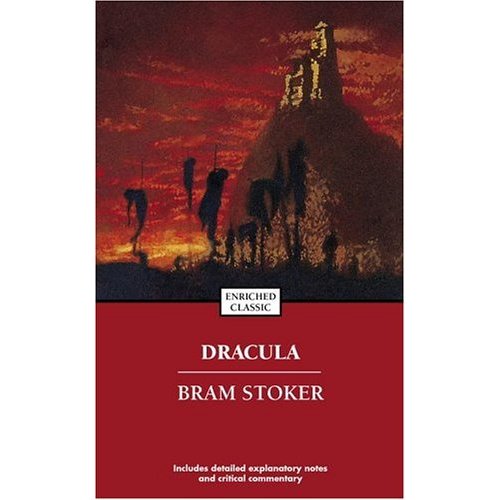
Dracula coverSo I went back to what many might consider source material: Bram Stoker‘s Dracula. He was not the first to cover this ancient ground (other well-known stories include Polidori‘s The Vampyre, and Le Fanu‘s Carmilla), but he is very likely the most well-known and most-referenced author of vampire fiction. The copy I chose is the Simon & Schuster Enriched Classics edition, with notes and commentary by Joseph Valente, a Professor of English.

[Though I enjoy books in which such additional information helps provide historical, social, political, or religious context, or discusses why something may have been important or overlooked by characters in the book, and so on, I sometimes wonder how much of the commentary is really just the commentator’s twisting of the text to fit an opinion, and how much is straight-forward observation of the material.]

Vampires and sex, an age-old coupling. The reasons are obvious: attacks that happen at night, usually on victims who are of the opposite gender to the vampires doing the attacking, and (in Dracula the novel) after the victims are in bed. And there’s the whole neck-biting schtick—which, as we all know, is more than a flirty little nibble.

There’s a lot of writing out there concerning vampirism and Victorian views of sexuality, and there’s a realm of scholarship that sees Dracula the character as freeing women sexually while Van Helsing, et al, try to suppress them. And, though the women seek help from their friends and send up prayers to God, they are drawn to the immortal count because their subconscious supposedly really, really wants him.

While such arguments might be made, there’s not much in the novel itself to support them. Yeah, vampires may work their mojo, but they’re presented as evil, and not all that sexy. Sensual, maybe, but not freeing. They’re rapists—even the females. After all, rape isn’t about sex or mutual expression or love. It’s about power and control.

Dracula controls Lucy. He controls Mina. Neither woman wants what he’s offering, and the men do what they can to stop him. Sure, they make some bonehead mistakes, like leaving Mina alone while they scout the count’s London digs, but I never get the impression they are trying to suppress either woman. In fact, Mina and Jonathan seem quite happy with their marriage. Until Dracula gets involved, of course.

to be continued

UPDATE: Last year, I read John Whalen’s excellent Western twist on vampires, Vampire Siege at Rio Muerto. You can read my review of his well-received novel here.

Musings: A Story Needs Trouble

Friday, I took a walk, a reward to myself for completing a freelance project, and a chance to be away from the computer and revel in the sunlight. (Aaaaaah! My eyes! My eyes!) When I returned home, however, I didn’t want to return to work. If there is an autumn equivalent of spring fever, I have it.

There’s not much story there, other than the old one: brain takes a walk while the body struggles to complete tasks by itself. Not very literary, eh?

How ’bout this: Little kids know a good story when they meet one.

A few days ago, four-year-old Sunny ran through the house, narrating as she went: “…and then there’s a tree…Oh, no! Watch out!…but Sky swoops in…”

She complicated her play by introducing obstacles and problems, but also enabled her pretend self and other characters to overcome those blocks by imbuing herself and her imaginary friends with creative skills or tools to deal with whatever occurred.

Last night, while re-watching a Korean television series that a friend had not yet seen, I saw specific points where — if the characters had been wiser, had been less ruled by fear or grief or anger or greed, had been quicker or stronger or less driven, the story would have ended much sooner than it does.

I was frustrated by the ugly motives that led to unnecessary tragedy, but acknowledged that — without them — the rest of the story would not only lose its power but its purpose. An intriguing, funny, poignant, suspenseful series would not exist.

To borrow from another post on this blog, stories are interesting because bad things happen.

Or, to borrow from the Chinese, “May you live in interesting times.” It’s a curse, not a blessing, the most interesting times being those with wars and natural disasters. Kinda the ancient Asian version of “Go to hell.”

I’m close to wrapping up edits on a client’s fictionalized autobiography…although I like this book, the ending is thin…

I headed downstairs this afternoon to fill my cup with fresh, hot tea, and that’s when I saw the problem: There’s a positive change in the lead character’s life, but there’s no transcendence.

Sure, the guy overcomes a crappy childhood, a weak and aimless youth, and a bout with addiction and alcoholism, and he’s definitely in a better place now, but–

What now?

And why did he finally decide that addiction was not the life for him?

Even in true-to-life stories, characters need a reason, a motive, and then action to back it up.

Otherwise, it’s not just the editor who’s falling asleep, but the audience is, too.

[borrowed from my post on Adventures in Fiction]

A horror story is playing out in the Middle East — not only there, but around the world — as adherents to a violent ideology behead, crucify, rape, torture, hang, beat, and exile anyone weaker or who doesn’t believe the same way or to the same extent as they. Similar atrocities have occurred throughout history, perpetrated by different groups in different places. Mankind conjures insane evil against itself and calls it good and justified.

And yet from this darkness arises life-changing, life-affirming stories.

One such is the recent travails of Miriam Ibrahim, a Sudanese woman accused of apostasy and adultery, and imprisoned in chains, because she married a Christian man, an American citizen. She even gave birth while in chains. She and her family were rescued and brought to the US in summer 2014.

Another such story can be read in The Hiding Place by Corrie ten Boom, which recently became a banned book in some libraries. It details how the ten Boom family hid Jews from the Nazis, how Corrie endured and survived a concentration camp, and how faith sustained her.

Powerful stories will be born of the current horror, as well. Tales will be told of pointless tragedy and humbling self-sacrifice, crushing dominance and inexplicable mercy, breath-stealing loss and unexpected gifts. Violence so vile it can scarce be imagined, let alone described, and yet compassion so kind one cannot help but weep.

Stories need something to overcome, and they need a reason to overcome it.

A candle is lost in the sunlight, but shines like a star in the dark.

Dragon’s Rook–the Evolution of a Book Cover

My friend and fellow author Keanan Brand is nearing the publication of his new fantasy novel, Dragon’s Rook. In June, I saw this post on his Adventures In Fiction blog: “Wanted: Cover Artist.”

When Keanan asked me if I’d draw the cover art for his book, I accepted the job and felt honored to be chosen for the work.  As a child the public library was my playground of choice and I suspect that deep down it has always been my dream to be a cover artist!

But there was a problem. I was trying to break into the design world via my Bamboo tablet (a graduation gift). I’d already faced the challenge of learning to draw on a flat surface while looking at the laptop screen to see where my stylus was pointing. How I wished I had a tablet with a screen as I struggled to get my hand-eye coordination right! For an artist used to drawing on paper, it was certainly my first hurdle to overcome.

Practice improved my skills, and I felt ready to try a larger project.

The Original Vision:

Keanan’s vision for the cover of Dragon’s Rook was a detailed drawing–

“Art involving a dragon eye, a massive claw gripping a pile of rubble, one wing wrapping the side and bottom of a crumbling stone tower, and maybe shadowy shapes in the dark distance. A cover that will still look good as a thumbnail image.”

My Vision:

Though I searched online for images to inspire the work, I felt drawn to the idea of a circle in the middle of the book cover. A single dragon eye, like the picture Keanan had posted on his blog. We talked about it, and Keanan liked the idea. It almost seemed to pay homage to a hardbound book he recalled from the Lord of the Rings trilogy.

The Eye of Sauron. The eye of the Dragon King.

We decided that a castle tower would be reflected in the pupil.

A simple and thought-provoking image, telling a tale, inviting the reader to open the book. Or in this case to purchase it for their e-reader, since Dragon’s Rook will be published electronically first.

Evolving Images:

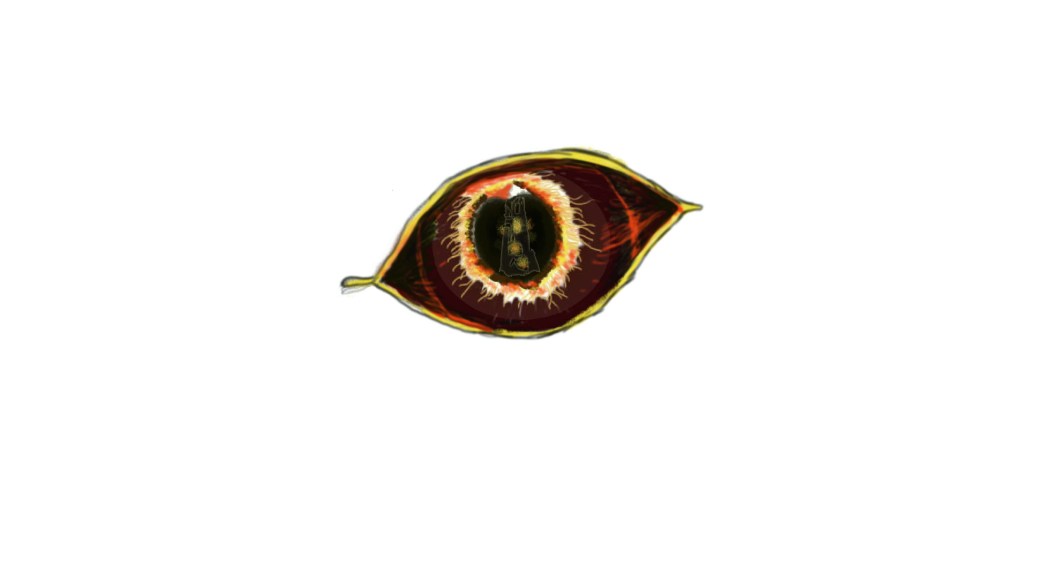
My initial offering was a rather menacing eye, but still not detailed enough to catch the reader’s attention as a thumbnail image. You can see this below.

dragon eye example

I also had a few hiccups along the way, including one image that looked a little bit like an olive. “Dragon’s Cook?”

dragon_eye_greengold

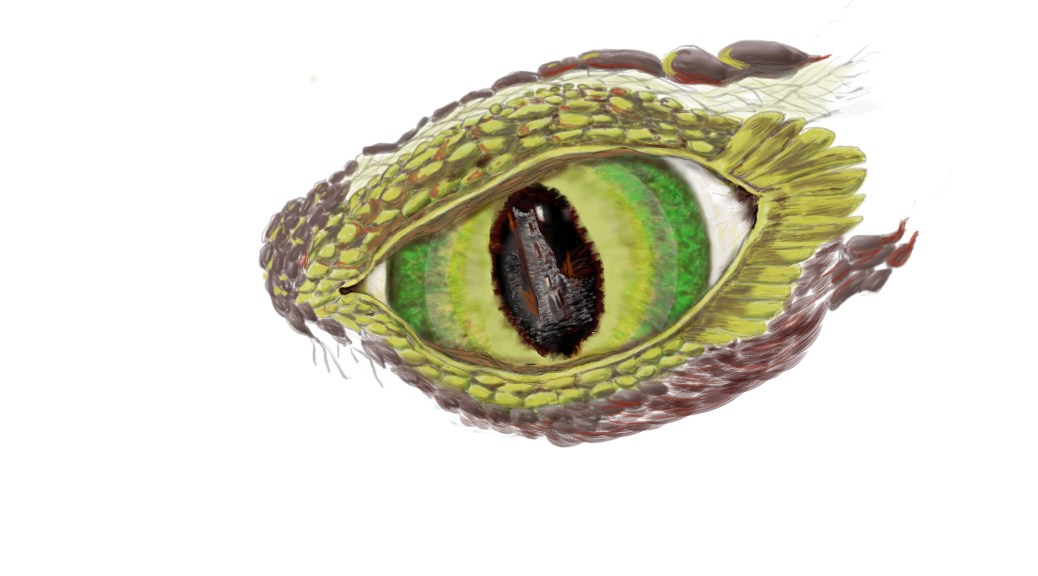
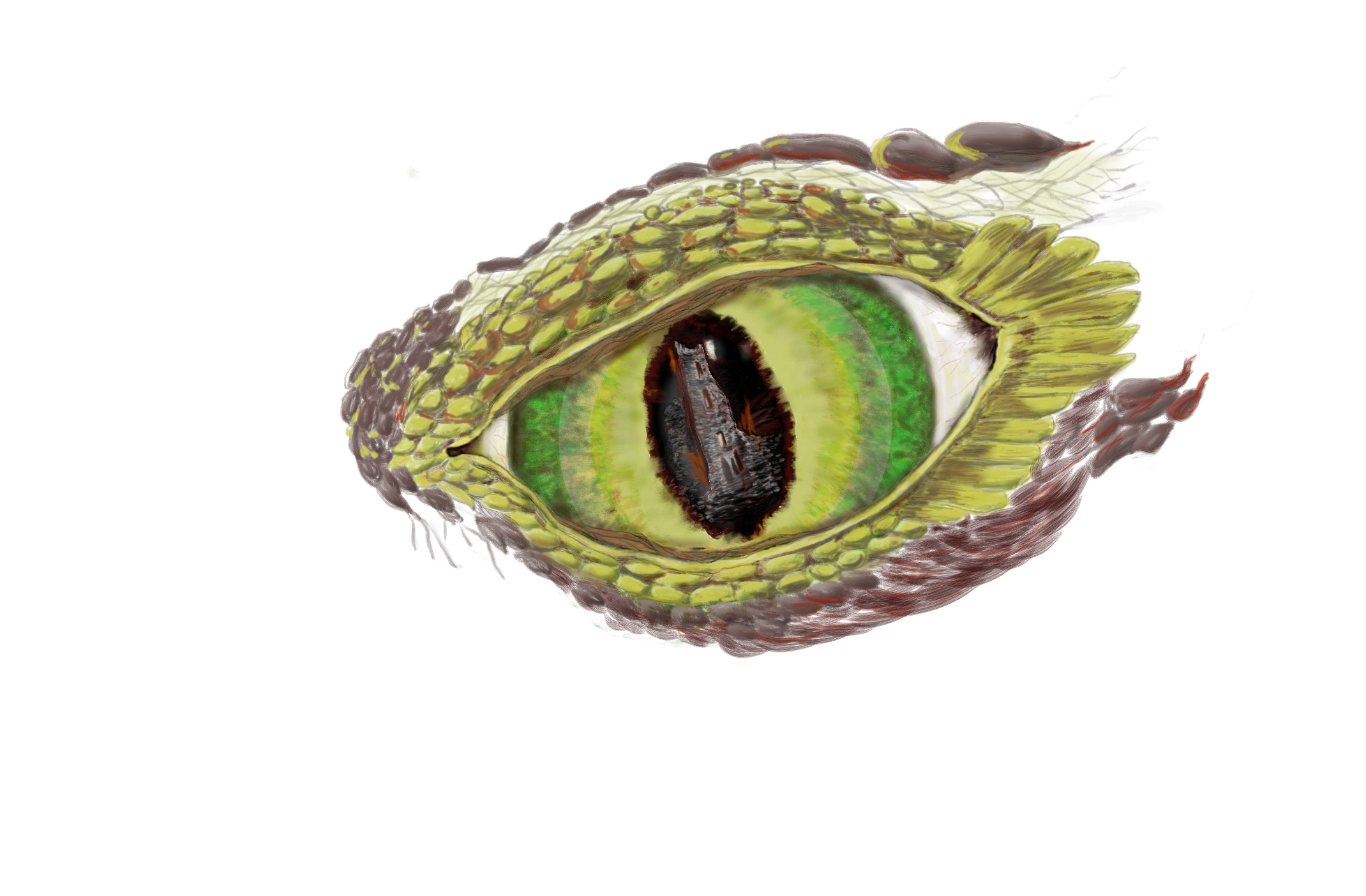
Finally the image began to look more like something we both felt was getting close to the vision.dragon_eye_greengold.sumo5

I wanted to add smoke and fire, but felt it would complicate the image too much. Keanan suggested creating a white for the eye rather than using the yellow background for the iris. I also wanted to add wrinkles to indicate the creature’s age.

I decided to build up the scales with the bevel effect with the Bamboo oil and dry brush tools. The scales reminded me of cobblestones. The bevel effect made them pop with an almost 3D-style!

The details faded as the viewer got further from the center of the eye. Like a tornado, the swirling scales pulled a sharper focus toward what the dragon was viewing.

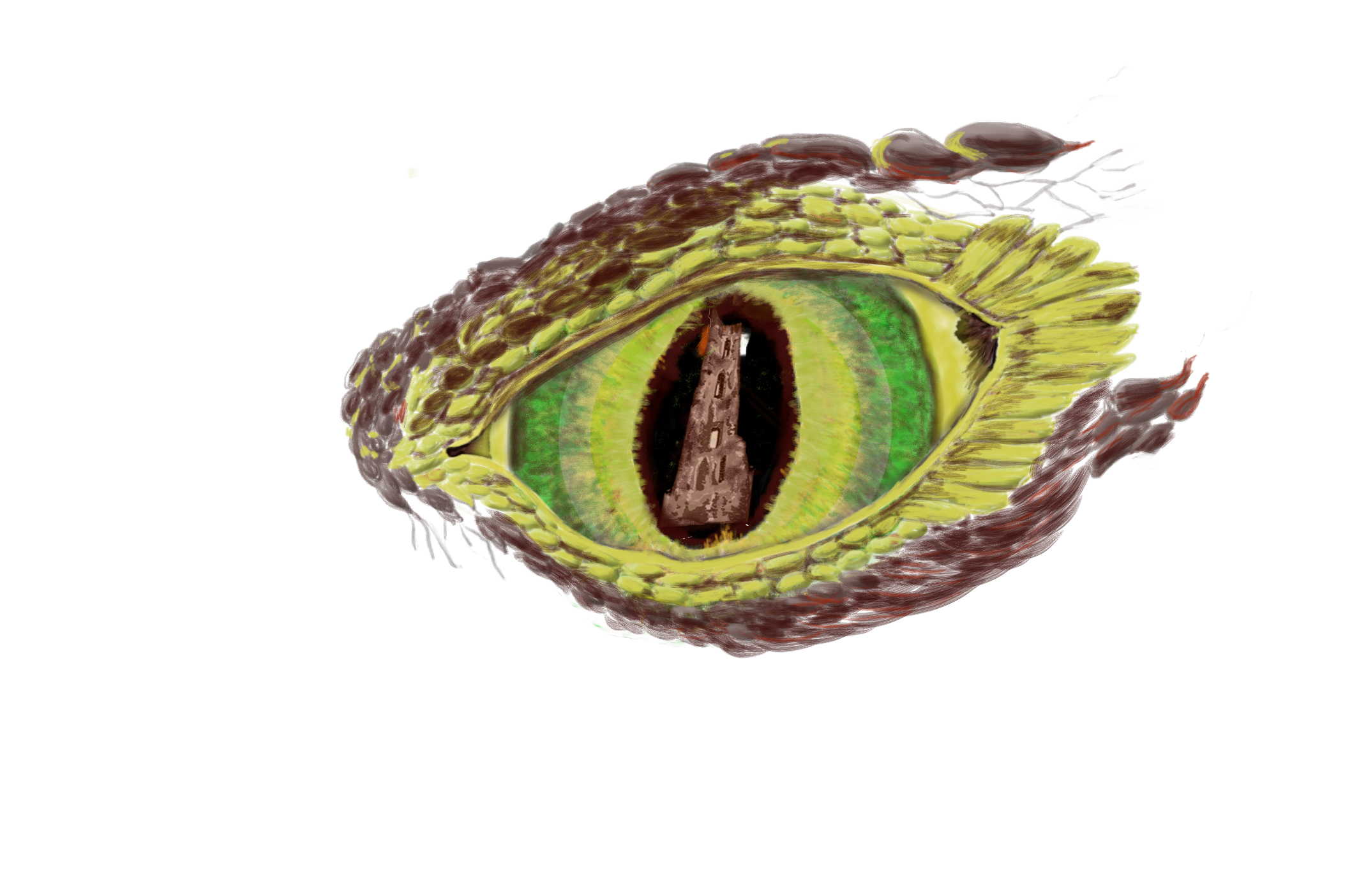
The Final Image in Progress:

dragon_eye_greengold.sumo7

We felt that our vision for the cover was simple, intriguing, and menacing!

Future Plans:

We plan to use a very similar style for the  Dragon’s Bane cover. This is the next book in the series, and it will feature the eye of a different dragon character, with a sword instead of a castle tower in the iris of the eye. This image is not shown at full size, but should give a good idea of our design plans for the book.

Feedback on this design is greatly appreciated as we finalize the project!

-Suzan Troutt, artist and author, art copyright 2014-

Dragon’s Rook–the Evolution of a Book Cover

My friend and fellow author Keanan Brand is nearing the publication of his new fantasy novel, Dragon’s Rook. In June, I saw this post on his Adventures In Fiction blog: “Wanted: Cover Artist.”

When Keanan asked me if I’d draw the cover art for his book, I accepted the job and felt honored to be chosen for the work.  As a child the public library was my playground of choice and I suspect that deep down it has always been my dream to be a cover artist!

But there was a problem. I was trying to break into the design world via my Bamboo tablet (a graduation gift). I’d already faced the challenge of learning to draw on a flat surface while looking at the laptop screen to see where my stylus was pointing. How I wished I had a tablet with a screen as I struggled to get my hand-eye coordination right! For an artist used to drawing on paper, it was certainly my first hurdle to overcome.

Practice improved my skills, and I felt ready to try a larger project.

The Original Vision:

Keanan’s vision for the cover of Dragon’s Rook was a detailed drawing–

“Art involving a dragon eye, a massive claw gripping a pile of rubble, one wing wrapping the side and bottom of a crumbling stone tower, and maybe shadowy shapes in the dark distance. A cover that will still look good as a thumbnail image.”

My Vision:

Though I searched online for images to inspire the work, I felt drawn to the idea of a circle in the middle of the book cover. A single dragon eye, like the picture Keanan had posted on his blog. We talked about it, and Keanan liked the idea. It almost seemed to pay homage to a hardbound book he recalled from the Lord of the Rings trilogy.

The Eye of Sauron. The eye of the Dragon King.

We decided that a castle tower would be reflected in the pupil.

A simple and thought-provoking image, telling a tale, inviting the reader to open the book. Or in this case to purchase it for their e-reader, since Dragon’s Rook will be published electronically first.

Evolving Images:

My initial offering was a rather menacing eye, but still not detailed enough to catch the reader’s attention as a thumbnail image. You can see this below.

dragon eye example

I also had a few hiccups along the way, including one image that looked a little bit like an olive. “Dragon’s Cook?”

dragon_eye_greengoldFinally the image began to look more like something we both felt was getting close to the vision.dragon_eye_greengold.sumo5

I wanted to add smoke and fire, but felt it would complicate the image too much. Keanan suggested creating a white for the eye rather than using the yellow background for the iris. I also wanted to add wrinkles to indicate the creature’s age.

I decided to build up the scales with the bevel effect with the Bamboo oil and dry brush tools. The scales reminded me of cobblestones. The bevel effect made them pop with an almost 3D-style!

The details faded as the viewer got further from the center of the eye. Like a tornado, the swirling scales pulled a sharper focus toward what the dragon was viewing.

The Final Image in Progress:

dragon_eye_greengold.sumo7

We felt that our vision for the cover was simple, intriguing, and menacing!

Future Plans:

We plan to use a very similar style for the  Dragon’s Bane cover. This is the next book in the series, and it will feature the eye of a different dragon character, with a sword instead of a castle tower in the iris of the eye. This image is not shown at full size, but should give a good idea of our design plans for the book.

Feedback on this design is greatly appreciated as we finalize the project!

-Suzan Troutt, artist and author, art copyright 2014-

Write What You Want To!

poet The old advice, “write what you know” has long been due for an overhaul, in my opinion. Some people treat it as poison advice to the writer. This is what they think:

What do most of us actually know? The daily office routine, traffic laws, relationships. All the mundane things that are in anyone’s life. Boring, right?

But these trivial qualities are the very things that keep us reading bestselling novels. I was never more aware of this than when I was reading through the Pendergast series by Preston and Child. A certain character had struggled against a rival  in another business(while having hair-raising adventures along the way) and I went to bat for him in my mind. Each of his victories against the man and his bosses made me believe in the character even more.

Then–spoiler–the character died. I was angry that this happened, because I believed in him.

Because I knew the struggles he went through. I’d been through similar ones myself.

As Countee Cullen says in his poem, “Any Human to Another,” we are never alone in our experience:

Let no man be so proud

And confident,

To think he is allowed

A little tent

Pitched in a meadow

Of sun and shadow

All his little own.–C.Cullen

So, write what you know. All your joys and sorrows, but put it into your fictional world.

Speak to your reader of the things that are human and universal.

My new proposal for the old advice: change it to–“When you write what you know, you can write what you want to.”


Granny, What Big Teeth You Have

Below is a piece of flash fiction written during tonight’s writers meeting. What a blast!

Each person contributed a portion of the premise: An eccentric millionaire lives in the basement of an apartment building, makes duct tape wallets for a hobby, always wears sunglasses (even indoors and at night), looks like an old grandmother, and makes rock-hard cookies.

We had about twenty minutes or so to create our masterpieces. The resulting stories were all over the place, from outright comedies to dark histories.

Mine falls more toward the comedic side. I forgot the duct tape wallets, but included an homage to Tim Hawkins. Enjoy!

What Big Teeth You Have

Damn kids.

I settle the sunglasses on my face and shuffle up the basement steps, rock music growing louder as I near the door leading to the lobby. In my pockets are the cookies I made earlier–hard enough to break a tooth. Or a young punk’s skull.

I unlatch the door and step into the hallway, the muted lights still blinding even through the dark lenses, and I blink, orienting myself. Music–if it can be called that–booms along the corridor and echoes in the lobby.

This is a nice place. Grandaddy built it as a luxury hotel, Uncle turned it into penthouses, and I inherited it after a family– Well, let’s just call it a domestic dispute.

Or a blood feud, if the absolute truth must be told.

Teenagers, the spoiled progeny of wealthy parents, pass around bottles of brandy and single-malt, drape themselves over furniture created by Fifth Avenue clothing designers, or dance to the jungle beats reverberating from the sound system stacked discreetly behind a potted acacia tree in one corner.

I put a hand into the pocket of my housedress and pull out a handful of cookies. “Pardon me,” but my voice is drowned by a howling note that pierces my skull even as it calls to my ancient blood. My ears twitch under the white hair holding them close to my head, and a bristle of hair stands upright along my spine.

Now, now, you mustn’t hurt them, but the cookies are already airborne, hitting their marks with greater accuracy than one might expect from a shaky little old woman like me.

The kids flinch and curse and look around. Blood trickles down one pup’s head, filling the air with its sharp metallic tang.

I grin, showing all my teeth.

Snack time.

c2014, EE