All posts by Penworthy Press

Penworthy Press is a collective of independent authors

Paper Mountains

I wrote this essay a few years ago for a contest. The entry didn’t win, but it still expresses my thoughts:

Paper Mountains

I believe many things, but what I am seeing clearer each year is this: life is too short to be blunted by the notion that what is difficult should not be done; that only what is easy should be attempted; that even noble ends, if they cannot be achieved instantly or with minimal discomfort, must be set aside and replaced by what requires little sweat, little patience, little sacrifice of any kind.

I am a writer. My publishing accomplishments are few: essays, articles, short stories, poems. However, I want to be a novelist, and to that end I put one word at a time on paper until I have a sentence, a paragraph, a page, a chapter, a manuscript. Some of my fellow writers tell me I am creating stories no one wants to read. I am doing what cannot be done.

But how does anyone know what the end will be? I am still climbing the mountain, and have not yet seen the view from the top. If others cannot see the mountain, is the mountain no longer there? Because others are weary, must I be content to sit beside them? If they seek another way, must I go with them? Must I convince myself—as some have—that half a journey is the entire trip?

Life so rarely happens as we would wish it. My teachers and friends were convinced that I would publish my first novel by age sixteen. That might have made me a novelty—no pun intended—but it might also have made a shallow book.

Now more than twice sixteen, I still have moments of doubt, of youthful uncertainty that anything I write is worth reading. Greater than my insecurity, however, is the knowledge that what makes me a writer is not measured by how I compare to others or how much money I make or how many people know my name, but by the fiery words that blister my brain and boil my dreams until the only way to cool my burning fingertips is to write. I am a writer because not writing is not an option.

Artists draw simulations of life. Photographers capture time. Sculptors push clay into action. Writers create movies for the mind.

The characters that people my thoughts are alive and very real, but they will remain in my imagination—unseen, unheard, unread—until I do the hard work and mold imagination into words on a page.

So the journey will pass—one word at a time, one page at a time—until the day I stand on top of the mountain and see that it is made of paper: reams and reams of it covered with words; wads of it tossed in to wastebaskets; some of it retrieved and smoothed out again and found to be not so bad after all.

This I believe: my greatest challenge is my greatest joy, and I would not have it otherwise.

c. EE

Patriotic Grandmothers

Several years ago, I wrote poems about my paternal grandmother and my maternal great-grandmother, both hard-working women I admired. (Good cooks, too!) They survived troubling times and circumstances I don’t even want to imagine, and they still smiled. Well, they complained a time or two, but what I remember most is their work ethic and their humor, although my great-grandmother’s was less apt to come out to play.

Both loved this country. One grandmother became pen pals with a president and his wife, and another came from “t’ Old Country” and never lost her accent.

Therefore, in honor of those strong women, and as my own nod to my rights as an American citizen on this Election Day, I offer these poems — not high literature, just simple, blunt tributes.

Elsie

Despite a generation’s haze,

her smile still shines

from the photograph,

a girl laughing,

grey head tilted,

audacious youth

in my grandmother’s face.

c. EE

My grandmothers died many years ago. Why, then, do they still seem so alive?

Immigrant

Ellis Island saw her come,

and Lady Liberty lit her way

across a continent

to the logging camps

far from the Old Country,

and something hopeful grew

in the muddy ground

she slogged while cooking and washing

for sawdust-covered timbermen.

Widowhood could not uproot the dream,

nor could a daughter’s disdain.

Faith’s fruit was bittersweet,

but she dwelt beneath its branches,

leaned upon its strength,

and tilled its seeds into my soul.

c. EE

There are times I still want to write them letters, or call them on the phone, or stop by for a visit. What better legacy than that?

New Directions: Old Career to New Career to No Career

This past year — past two years, actually — has been an exercise in living differently. I had the same house and the same job for many years, encountered challenges that took my down and some that spurred me toward newer or better goals, and experienced sorrows I’d rather never happened and joys I never expected.

However, after a weekend with a friend — her brother’s wedding, and all the craziness and fun that entailed — I realized something had to change. Before we said goodbye, we decided that 1) I would prepare my house for sale, and 2) we would return to school and change our careers.

Well, she achieved school, and will graduate in 2013. I was set to start classes, but circumstances conspired otherwise, and I withdrew. An injury kept me semi-handicapped for months. Then family news brought about another change in plans. Then the house sold.

I left it and the old career last year, and turned a part-time editing business into my main endeavor. I made enough money to cover expenses, but I grew to hate editing. I became stressed, easily annoyed, and snappish. In contrast, on writing days, I can be daydream-y and in my own world, but I tend to play well with others, and sleep well, too.

So, last week I came to a decision: I’m going to honor my contracts, and then I’m done editing for a while.

No freelance stuff, no publisher stuff, just my own writing.

Might not be smart from a fiscal standpoint, but I’m hoping for fewer headaches, less frustration, and more creativity.(Translation: more writing.)

Is there something you can do well, but you hate?

____________________

Still trying to catch up on my NaNoWriMo word count, but have been battling illness that saps creativity along with energy.

Regardless of reaching the 50k-word goal or not, I’m using this month as an opportunity to finish a novel that’s been languishing for two or three years. Yeah, the point of NaNo is create something totally new, and be unencumbered by trying to make the new material fit an existing project, but I’m a rebel. Either way, I figure I’ll come out a winner.

Beginning the NaNo Frenzy

Deep in the maelstrom of NaNoWriMo, there pulses a light — many lights — the arcing neurons of my brain as they create utter nonsense that will, perhaps, be crafted into something sensical after November ends.

I’m already one day behind in the daily word count, but that dragon shall be slain as soon as I can figure out how to shoot this ray gun.

Oops! Mixing genres. Ah, well. That’s the hazard and the joy of NaNo.

————————-

For those readers who enjoy science fiction, specifically the sub-genre “space opera”, there’s a serial being posted every Saturday over at Adventures in Fiction blog. Keanan Brand’s series was being published in Ray Gun Revival; however, the magazine is on hiatus, so he went back to the beginning, and is posting the original episodes while writing new material to finish the series.

If someone was a reader of the series over at RGR, and now wonders at the unexpected titles or short lengths of the episodes, that’s because he’s breaking down the originals into smaller, more blog-friendly pieces.

Obtain a current list of episodes by clicking here. Reading is free, so go over and enjoy!

Reformation Day

Today is Reformation Day, in honor of Martin Luther and the Reformation that resulted from his 95 Theses nailed to the church door in Wittenberg.

No, I will not be preaching sermons or dissecting doctrines.

Despite its flaws, I enjoy the film Luther, and think the filmmakers did a good job telescoping time and telling an epic story in only two hours. Catholics may not like the film so much, and even many Protestants aren’t happy with it, but I offer solely my opinion.

And one of my favorite songs by Wes King is “Martin Luther” (from The Robe, 1993):

VERSE:

On the eve of All Saints Day

The year was 1517

Absolution paved your way

A piece of silver set you free

One man stood from the rest

Was compelled to confess

CHORUS:

I’m gonna light me on fire

Flames of truth are burnin’ me

I’m gonna light me a fire

The world will come to see

The truth that’s changing me

VERSE:

The chapel ceiling’s austere

No man would dare question Rome

Superstition and fear

Woods filled with fairies and gnomes

The door of Wittenberg

The truth was finally heard      (chorus)

BRIDGE:

image from noiseofthunder.com

I cannot

I will not

Recant

I cannot

I will not

Recant

Here I stand

VERSE:

Five centuries have come and gone

His flame has not been forgotten

‘Cause today I sing his song

A Mighty Fortress is Our God

With growing certainty

This truth prevails in me      (chorus)

Some celebrate Halloween. I celebrate a transformed me.

Raising the Bar: Does Your Writing Sink or Soar?

Think your editor is unreasonable and demanding?

Think he hates you, your writing, every breath you take, and probably your grandmother, too?

Consider the situation from his point of view, and ask yourself, “Why should my work be read by the world?”

To help gain perspective, read this post over at Keanan Brand’s Adventures in Fiction blog: “The High Cost of Too Nice: An Editor’s Rant“.

As I see it, an editor’s job is not only to encourage writers, but to challenge them, to draw from them better and better work. It it isn’t to be so “nice” that they don’t feel the sting of failure, or that they never confront reality: “You’re good, kid, but you’re not there yet. Do it over.”

The cost of “too nice” is lazy, naive, or ill-equipped writers, as well as disappointed, annoyed readers whose online and word-of-mouth reviews will cost book sales. More importantly, readers will have little or no respect for authors who produce below-the-bar work.

And what of the publisher’s reputation? Or the editor’s?

Agree or disagree? Have a rant of your own? Post it here, or over at Keanan’s blog, and let the conversation commence!

Moments

A friend reminded me of a story snippet I wrote a few years ago, which sent me on a hunt for other old things among the stacks of yellowing paper. Sometimes, I read my old writing and cringe at its clumsiness or pomposity. Sometimes I smile, remembering the moment.

This poem is one of those moments: Driving home from work one clear night, I looked up to see a crisp sliver of moon, and thought with a laugh, “It looks like a needle.” The poem composed itself, but I had to keep repeating it until I arrived home and could write it down.

Seamstress

I turn my face up to the sky

and watch the slivered moon

hang upon a blue-black night

like the spindle of a loom.

If sky were cloth, and I were skilled,

and stars were buttons bright,

what a wond’rous garment we would yield,

and hem it up with light.

c. EE, year unknown

The next poem is not a moment but the culmination of years, an understanding friendship. This friend and I no longer speak, except through occasional “hi, how are you” messages sent via my mother whenever she happens to see him. Sometimes I wish I had honored the poem’s last line. But if friendship is valued, so should be the truth.

Secret

Turning the envelope in my hands,

staring into space,

I see things that are not there—

a beloved face,

brown eyes, the sunlit room where he stands,

laughing, watching me.

Will courage rise? Will I dare

hope to ever be

more than confidante or casual friend?

Phone calls and letters and inside jokes,

shared smiles, birthday cards,

minds so akin we forget the time,

conversation marred

by what remains unspoken—

a delicate dance

of reaching out, holding back, a mime

lest life send a lance

to pierce the bright dream and make it

end.

I seal the letter, write an address.

What is left unsaid

ensures friendship will endure,

its heart still unmet,

mute, a gift speaking more than a kiss

though less than the truth.

I will love and never tell.

c. 2006, EE

Journeys

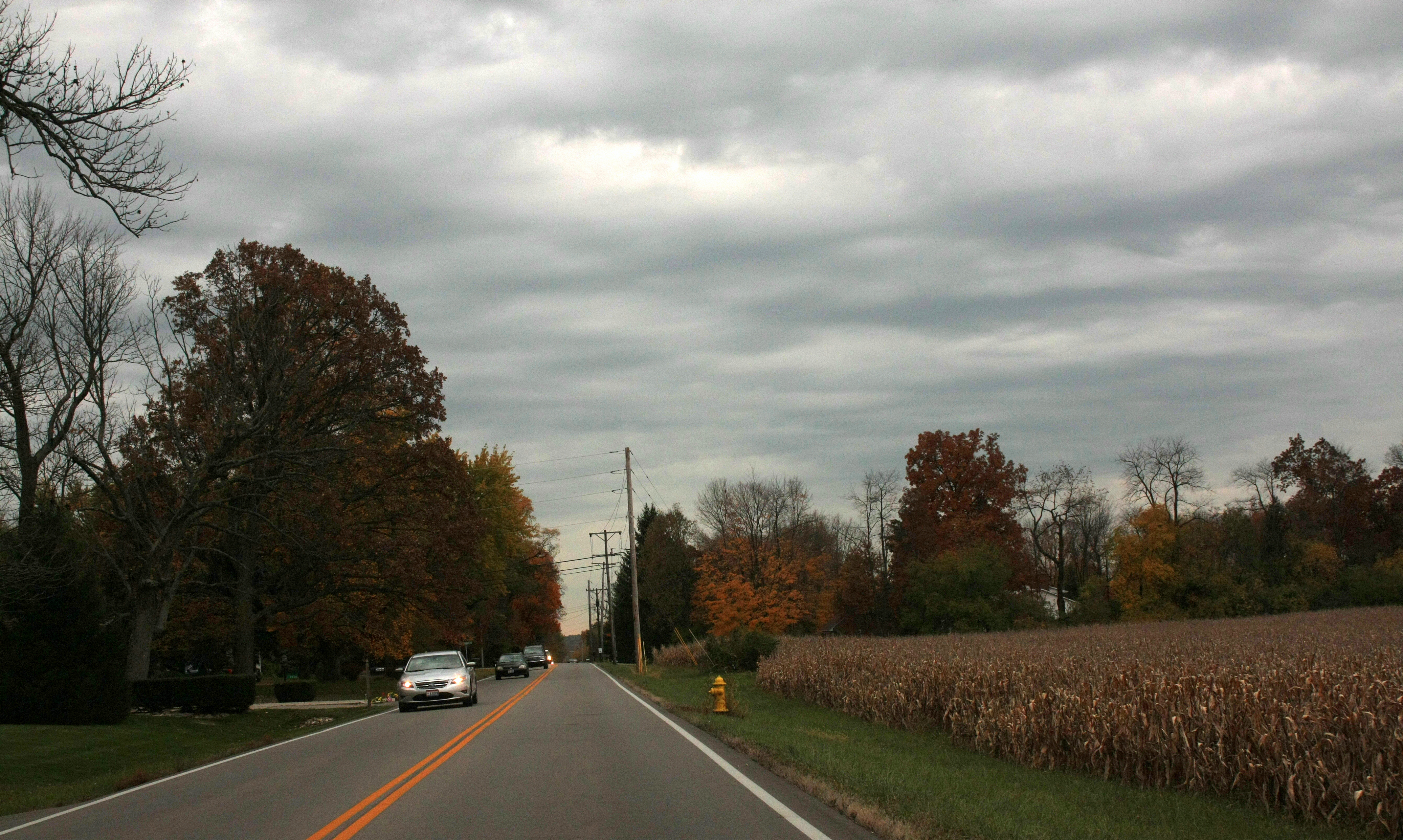
urban meets rural, October 2012

I’m daring.

I take photos while driving.

Just point the camera ahead of me and shoot, hoping for the best. After all, there’s no way I’m holding it to my eye to frame the perfect shot. Most of the time, after sorting through them, I toss nearly all the photos.

Some of them, however, turn out well, such as these autumnal shots taken a couple evenings ago, one on the way to my first errand, and the other on the way home after my business was ended. The sky, while overcast, was interesting, and cast a different light as the evening progressed.

hazy evening, bright foliage            October 2012

Sometimes, I point the camera out the side window, but with far less useful results. Still, despite clutter and darkness, this shot shows the moody sky with a hint of light in the west:

cloudy sunset, October 2012

I wish I could document all my journeys. Remind myself where I’ve been, how far I’ve come. Remember there’s still a road, that this is not all there is.

Ohio farmland, September 2012

But that, I suppose, is what stories are for: They are signposts, maps, siren calls.

There’s a world to see. Pack light.

Expectations

Happens all the time: I expect one thing but get another.

I like simple things. Direct things. Pretty’s all right, too, but that’s subjective and can be a trap.

at the Crescent, 2011

The fireplace pictured here is, in reality, simple: a mass of bricks laid out in a plain pattern intended for functionality rather than form. But even functionality is questionable, because the heat from the fire doesn’t translate into the room. The friendly flames lead me to expect warmth, but, in the end, deliver only cheery light.

After the fireplace was built, ornate overlays were added, drawing the eye away from the original stolid, mundane appearance. It’s trying to be more than it is.

An aside: The circular decoration conjures the image of a pipe-smoking hobbit with his feet propped near the fire.

Ever read a book that’s trying to be more than it is? As if the author thinks he can distract us with the pretty-pretty lights so we’ll be too dazzled to realize how shallow it is?

I’ve watched movies like that — many in the superhero vein, but many based on bestselling or classic literature, as well — and left the theater with a sense of disappointment that I might not even be able to articulate in that moment. Hope had been deflated by something I could not quite name until later, when the dazzle had dimmed and reality could shine a sharper light.

Under a pseudonym, I write sprawling fantasy with deep history and mysterious characters. One thing that’s helped me create the world is to simplify the language in which it’s presented. The original version is heavy with complicated sentences and old-time wording. Now, drafts and drafts later, and with the second book almost complete, some of that remains, but more as flavor than as the whole meal. Readers of the early drafts had difficulty wading through all the verbiage to get to the story. They expected a compelling tale but encountered a murky mess.

I was so enamored of the trappings that I forgot to tell a story readers could understand. I forgot to make it simple.

There are books known for their parts: evocative settings, witty dialogue, realistic characters, exquisite detail, elegant turns of phrase. Some are known for their provocative subject matter, grand themes, epic scenes.

Done well, such books can envelope readers in a rich world of imagination, one which those readers are reluctant to leave.

But is there a quiet, simple book that speaks more than its gaudier neighbors on the shelf? Why?

Blue Zoo

There’s a new site for writers who need inspiration, encouragement, and training:
Blue Zoo Writers, formerly The Writer’s Handbook.

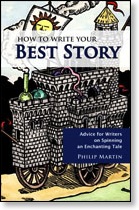
It’s conducted by Philip Martin, author of the excellent volumes,  How to Write Your Best Story (read a review here) and A Guide to Fantasy Literature, as well as proprietor of Crickhollow Books.

Martin is also an editor, speaker, and publisher, and can be contacted via Great Lakes Literary.

Writers can subscribe to receive blog updates via e-mail, and there are tips for young writers, as well as core advice for those of us who have been pursuing this craft for a while. Martin will be adding a list of resources as he continues to build the site (which is already chock-full of good stuff), and would likely welcome any input from other writers and editors as to books, groups, classes, etc., that might serve the writing community.

I met Martin several years ago at a writing conference, and enjoyed our conversations — but, of course, I’ll talk to any writer at any time about anything remotely related to writing! — so I encourage everyone to go on over and strike up a dialogue.