This week, I’m visiting family for Christmas, and one might think that, after many months away and long hours of travel to return, I might forego any editing work or writing, and spend all my time in the warm embrace of close kindred.
That embrace has not always been one of comfort, but of control and bought affection. It smothered. It threatened. It even attempted murder.
More than once.
But some of us broke free. We left those we thought we loved, but whom we knew could not love us.
Holidays assayed in their presence often ended in fights and ugly words, and sometimes violence. Our final Thanksgiving with them, my father beat his brother-in-law—not because Dad was spoiling for a fight, but because he was protecting us from an unwarranted and unexpected attack. Thank God Uncle’s head had just been buzzed, or Dad would have grabbed a fistful of hair and beaten Uncle’s head against the gravel driveway.
Lest you feel too much sympathy for him, here are a couple examples of violence against us children: Uncle had tried to hit my infant cousin’s head with a shovel (my aunt turned, shielding her son, and was herself hit with the shovel). Years later, at the aforementioned Thanksgiving, that same cousin’s older brother and I were almost smothered inside a sleeping bag when Uncle wouldn’t let us go.
So you’ll understand why I say, “Thank God Uncle’s head had been buzzed.” I’d rather never see that man again than lose my father for murder.
A later attempt to return for a summer visit—the last time I entered that house, hoping that family could mend—resulted in weapons being turned on us children as a threat to our parents.
That was the first of two times I’ve stared down the barrel of a gun.
Over the years since, we’ve had to learn what love looks like, how it feels, acts, speaks. The old taint tries to creep in every once in a while, tries to steal understanding with impatience, to replace humility with contention. Pride has no place in love, nor does selfish superiority. Love seeks the good of others, not for anything it can gain, but for everything it can give.
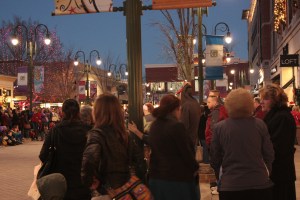
tree lighting c. 2012, EE
It’s a shared laugh, a shared burden, even a shared shoulder. Sometimes it speaks just the right words, with or without tangled tongue, and sometimes it holds its peace.
One of the most well-known, oft-quoted definitions of love, one we can all embrace:
Love is patient, love is kind. It does not envy, it does not boast, it is not proud.
It is not rude, it is not self-seeking, it is not easily angered, it keeps no record of wrongs.
Love does not delight in evil but rejoices with the truth.
It always protects, always trusts, always hopes, always perseveres.
Love never fails.
(I Corinthians 13:4-8, NIV)
This holiday season, I wish you peace, hope, and much love.
* * *
UPDATE (12-21-12): In an ironic twist, who should call this afternoon but the uncle mentioned in the post above. He wanted to speak with my mother, but she was at work, so he chatted with me. Yes, chatted.
Thirty years, thousands of miles, and a great amount of both reflection and forgetfulness can lead to mutual Christmas wishes. Crazy. And full of grace.
I’m currently editing two manuscripts for a publisher (one is a suspense novel, the other YA romance). After sending back the second round of edits on one manuscript in the wee hours of morning, I gave myself a mental break Wednesday: I sorted old writing notebooks.
That may not seem like a break, but for someone still finding her way with a neglected, unfinished manuscript, going through old notes is like a refresher course in creative writing. There are dialogue scenes that are pithy and pointed; action scenes that I wish continued past a few paragraphs; plot notes about threads I’d forgotten. Reading this material as if it were the work of a stranger, I became so absorbed that I didn’t even hear the call for supper.
It’s daunting, to tell the truth. There’s so much there, how can I ever hope to organize it into anything usable? Some of the material is moot now — I’ve already incorporated it into the manuscript, or the story took so different a turn that those notes no longer apply — but much of it is exciting, reminding me why I wrote the first book, and why this book must be written.
I found epic poems and humble prayers, a couple old maps penciled on blue graph paper, a scene from the point of view of an invisible boy.
Those notebooks are like the rich aromas of a home-cooked meal, tantalizing my senses until I can scarce wait to sit down to the feast.
So, I unwittingly started a kerfuffle when I posted my response to a literary discussion concerning the “rules” for prologues.
And, since I didn’t toe the expected line, someone presented me with a bit of a finger-wagging scold.
Scold away, I say!
Here’s what the fuss was about:
A gentleman posted a topic for discussion, and in his post he stated, “(S)ome people have made comments about prologues in novels that surprised me. It seems that different people have different views on them and their purpose. Not all novels need a prologue. But for those that have them, to my mind, a prologue is a teaser.”
Then he presented a list of what a prologue should or should not be, and ended with the question, “Agree/disagree?”
Some folks agreed with the list of rules, some took exception to a point or two, and one gentleman gave this response:
A good subject to raise in view of the various opinions expressed elsewhere…True, prologues are often short, but I don’t think the length matters too much so long as the piece is well-written…Prologues seem to fit into some works more than others. Have a look at Ken Follett’s “The small boys came early for the hanging etc” in his prologue to The Pillars of the Earth. If you don’t read it you miss a heck of a lot; it both teases and foreshadows and, in my view anyway, is necessary.
Follett’s sequel World Without End doesn’t have a prologue. I found it interesting to compare his techniques.
Logical, with some backup material to support his remarks.
Then I waded in.
I’m leery of rules. And I’m especially leery of rules that are based on a particular writer’s (or group of writers) preferences.
Although there are some painfully bad prologues in this world, there are many that exhibit fine examples of condensed storytelling.
A prologue isn’t always necessary, true, but if it’s there, it needs to carry storytelling weight. It can reveal history, it can tease future events, it can be a scene that doesn’t fit neatly into the main body of the text, but it must, must, must add to the story.
Arbitrary rules go out the window if they exist at the expense of story.
Someone disagreed:
(R)ules…develop in response to trends & needs, & to avoid chaos. They help prevent newcomers from reinventing the wheel.
The list that started this thread is open for debate – thus the purpose of this thread, so they may or may not represent generally accepted rules.
The “rule” I live by is “you gotta know the rules to break them” (& to know if/when/how/why to break them).
Before breaking them or deeming them arbitrary, it deserves our attention to know if they really are rules, & why they exist.
Before passing judgment on whether rules ought be broken, I think we’re just establishing what basic rules exist in the fiction world re: prologues. Whether to follow them is another matter.
Okay.
I’m all for knowing the rules. After all, they exist for a reason. My objection in this case is notion that prologues have rules.
There are writers who abhor them and writers who love them; writers with poor prologue execution, and writers whose prologues are poetry or exquisite short stories. Prologues are short, long, back story, future action, teasers, packed with information, and so on. Prologues are as different as the writers who write them.
My response:
Who or what is the arbiter of the prologue rules? Is there one? Why must a prologue (or an epilogue, for that matter) be subject to rules, outside of helping to tell the story?
Just as in other areas of life, there are bandwagon issues in literary circles: “never use an adverb” or “never use flashbacks”, and so on.
These “rules” are often preferences, not grammatical or mechanical necessities, or storytelling must-haves.
And though I can advocate for knowing the rules in order to break them well, I still argue that the prologue issue (should a story ever have a prologue, or what must a prologue include?) is not itself a rule, but a preference.
The written word is limited in its ability to convey tone of voice. That is evident in the response below, because the author has read into my words something that didn’t exist when I typed them:
So the opinions here are negated, unnecessary & this is a silly discussion?
…Just because no one’s yet (to my knowledge) written a book about the prologue & laid down rules doesn’t mean some unspoken rules exist…I’d further guess a lot of publishing houses have very definite, articulated rules re: prologues, written for all editors to heed (& break when appropriate).
Preference or not, it’s good to know what the literary preference is, figure out why, & know when to or not to heed it.
By answering here, I’m trying to return to the subject & take the confrontational tone out. Please follow suit.
Well, that’s a head-scratcher. I was never off topic. Never said anyone’s opinion was negated or unnecessary, never said the discussion was silly. Confrontational tone? I can see how my questions might have seemed that way. I objected to imposing rules where none exist.
Nor, in my opinion, should such rules exist. There may be a basic story structure we all employ — beginning, middle, end, with an arc of rising action, climax, and falling action — but we all use that structure to serve our stories, not twist our stories to serve that structure.
Some tales are told inside out. Some are told backward. Some rely heavily on dialogue, some on action. Some are introspective, some spend very little time in the main character’s thoughts. Some have epilogues or prologues. Some use lines of poetry as chapter titles. Some only number their chapters. Whatever works. Whatever serves the story should be used.
I hate seeing young or rookie authors being hemmed in by storytelling “rules” that are imprisoning and arbitrary. One editor said she hates the word atop, and will strike it from every manuscript in which it appears. At a conference several years ago, the keynote speaker (a woman) said that women should not write battle scenes, because women are too soft to write with real grit. One writer likes to keep his descriptions to one sentence, and another likes to invite the reader into the scene by including an entire paragraph.
Different approaches, but certainly none of them following a rule authors can point to in a grammar book or a storytelling guide.
NaNoWriMo is over. I barely broke 30,000 words, so I didn’t win a web badge or a downloadable certificate, but progress was made on a dusty manuscript, too long neglected because its author is too easily distracted. With life tugging on my attention, I need to remember why I write. I need to remember to write.
Ever have those days when you forget to eat? Or go for hours before remembering that, oh, yeah, the reason you originally left the office was because you had to use the restroom?
Lately, that’s me and writing.
After about a year or so of acute manuscript neglect, I’ve lost my way with the plot, characters, dialogue, you name it. This past month, I floundered in a mire of old notes, some so oblique I no longer know what I intended.
It’s not that I haven’t been writing. I’ve been cranking out all sorts of small projects, just not working on any of the unfinished novels. The only complete manuscript has been sent out, and is most likely lying in a publisher’s slush pile, awaiting perusal by a reader who will decide whether or not it advances to the editor’s desk.
Despite uncertainty how to proceed, I haven’t grown bored with the novels. If the author’s uninterested, how much more the readers! No, it’s time to become reacquainted with the stories. If I can’t recall my original intentions for their progress, well, then, who says I can’t imagine something new?
When I asked a plot question of a fellow author whose romantic suspense novel I recently edited, she replied, “The story has to happen that way so (a later dramatic event) can happen.”
She refused to plug a plot hole by approaching her story from a new angle. I’ve been there a time or two: This must happen because that must happen.
waiting for the parade c. EE, November 2012
Says who?
Says me?
Well, since I’m in charge, I can change my mind. I can adjust the plan, redirect the characters, change the venue of an action scene, put one character’s dialogue into a different character’s mouth. It’s all in my hands. I am the master of the universe! Bwah-ha-ha-ha!
The following short-short story was written October 10, 1995, in a journal I kept beside the bed in order to record thoughts and ideas, even dreams. I still keep a journal by the bed.
This little tale came just as I was falling asleep, and I haven’t done anything to it since, except for transcribing it to the computer. It came to mind this Thanksgiving as I considered all the things for which I’m grateful, and how sometimes blessings come in disguise.
Treasure
One day, the young boy’s tutor tried one last time to show him the unimportance of physical beauty. The boy, handsome and groomed and well-deported, was nonetheless reluctant to follow his tutor’s request to enter the small, out-of-the-way room.
“Very well, then,” said the tutor, calmly closing the door and dropping the heavy key into his pocket. “We shall leave these treasures for another time, and immerse ourselves in a sea of mathematics.”
The handsome boy shook his curls and thrust out his chin. “No! Show me this room!”
The tutor’s brows arched. “Oh! I’m so sorry, Master. I thought you were not interested in this room.”
“I’d rather see this room than study more numbers!”
“Then mathematics, it is.” The tutor tucked a large volume securely under his arm and proceeded toward the library at a quick and deliberate pace. Reluctantly, the boy followed, scowling and far slower than his teacher.
Later, while laboring through a particularly intricate piece of poetry, he looked up suddenly and demanded, “What is in the room?”
The tutor shrugged and twirled his pen. “Oh, nothing much. Then, again,” he leaned across the desk, “it could be something very much indeed.”
He held up a mirror that lay beside a lamp. “Look into this.”
The boy did so, and smiled. It was a pleasing sight, he thought, adjusting his collar and smoothing back his curls.
“Is it you?” asked the tutor.
“Of course, it is!” replied the boy, astonished yet sneering. “What would you expect?”
The tutor smiled. “Oh, no! This is merely an image, a reflection of the real person.” He brought the key from his pocket. “Are you ready for the room?”
“Oh, yes!”
The boy kept himself in check by squeezing his hands together behind his back. The tutor seemed to take an eternity just to unlock the door. It finally opened quietly, falling back to reveal shelves full of old money caskets. Some were plain, some were carved; some were of wood, and some of gold or silver. All were covered with dust.
“Now,” said the tutor triumphantly, “choose the casket with the treasure.”
The boy’s eyes brightened, and he walked toward the shelves slowly, almost reverently. He reached out to open a beautifully embossed casket.
“No, young sir, do not touch. You must go by appearance alone.”
The boy moved down the row. Suddenly, from the corner of his eye, he saw the glitter of a jewel-encrusted lid. Eagerly, he reached for the casket, blew off the dust, and turned to his tutor.
“This is the one!” he crowed.
The tutor just smiled. “Open it.”
The boy threw back the lid, then exclaimed in disgust, “Why, there’s nothing here!”
“Of course not, dear boy,” said the tutor, unruffled. “Try again.”
This time, the boy chose a gold box. Nothing. He picked a silver casket. Nothing. Soon, all the most beautiful caskets were piled on the floor, open and empty. The boy turned to his tutor, eyes flashing.
“What kind of silly game are you playing?” he asked, his face flushed and teeth clenched. “There is no treasure here.”
“Oh, but you haven’t looked yet!”
“What?!” The boy gestured at the pile. “What is all this, then?”
The tutor smiled. “Do you recall a Scripture passage about a treasure hidden in earthen vessels? You would never expect water to come from a wine bottle, nor wine from a common pitcher, would you? I thought you liked a good battle of wits, lad. Try again.”
The boy looked around the shelves one more time. In a spirit of vengefulness, he grabbed the plainest, most scarred casket and flung it open. Inside were lumps of hard black wax.
“Here’s your treasure!” he mocked, thrusting the box at his teacher.
“Why, so it is!”
“You can’t be serious!”
“But I am!” The tutor reached for one of the black wax objects and broke off a piece. Suddenly, an emerald and a patch of gold glittered through.
“What does all this mean?” asked the bewildered boy, gesturing at the caskets surrounding his feet, and indicating the beautiful ring that now lay in the tutor’s palm.
“All that’s gold does not glitter,” the tutor broke open another wax ball to reveal a pearl and diamond brooch, “just as beauty does not indicate goodness.”
He looked the boy straight in the eyes. “So, tell me, did you see yourself, or merely an image, in the mirror?”
[The above story was written just now, for the first time, so it is quite rough. However, I had to write it down before it was forgotten.]
c. EE
The writing is a bit pretentious and awkward — hey, it was scribbled down in a rush! — but I may clean it up someday, maybe compile an anthology of my short writing (essays, poems, stories). It’d be nice, too, if my photography skills had advanced enough that I could enhance the text with photos. Someday. Right now, I’m working on a novel-length manuscript, and then there’ll be another two novels (at least): one incomplete, one not yet begun. I’m not sure which is more difficult: a sprawling novel that allows me room to explore the characters and the setting, or a short story that forces me to keep the narrative pointed and contained. But that’s fodder for another blog post.
A scheduled writers meeting could have gone awry Sunday afternoon. We arrived to find a sign on the door: the cafe was closed due to maintenance issues.
When we retreated to our second option, the establishment was full to overflowing: no parking, no tables.
The weather, however, was beautiful. November eighteenth, sunny and mild. An unexpected blessing.
So we pulled two of the metal outdoor tables side-by-side, ordered food and drink, and commenced writing. Only as the sun slanted westward and cast us in shade did we finally go inside. By then, however, the cafe had emptied, and we could spread out our notebooks and computers, and warm ourselves by the fire.
In one of our writing lulls, when we shared ideas and quiet conversation, I recalled this poem, written extemporaneously on another autumn afternoon:
Today’s post is a mix of my thoughts on “point of view”, as well as a re-post of an entry from July 2008, revised slightly by its author, a writer and editor whose greatest peeve is laziness in the writing process. He lays out the basics of POV in a way that almost anyone can understand.
When I was younger, I used to write in the vein of the books I grew up reading, many of them being older works with third-person omniscient points of view. I didn’t know the technical term, nor did I even consider such a concept as POV, but once a junior high English teacher pointed it out to me, I realized that the right point of view can make a story come alive.
At first, however, I resisted. After all, third-person limited was so, well, limited. In the years since, however, it has become my default POV when composing a story. However, I have wandered into first-person on occasion, and have even played with tenses. Most books are written using past tense, but I’ve come to appreciate and enjoy the immediacy of present tense.
Now, without further ado, I present a soap box and a lecture.
Remember that cliche about opinions: Everyone has one?
Here’s another old saying: You can lead a horse to water, but you can’t make him drink.
After reading the opening pages of a novel that I freelance edited—twice—I’m wondering where my advice went. Down some literary drain, I guess.
POV (point of view) is one of the simplest things to get right, yet one of the most difficult concepts to communicate.
Definition: The story or scene is told from the point of view of one character in the scene—and ONLY from that person’s perspective—or it is told from the point of view of an omniscient narrator (an objective imaginary individual who sees all and knows all, and communicates that to the reader).
Third-person limited POV: All that fancy term third-person limited means is this: The reader is not jerked from character to character in a mind-hopping exercise, jumping first into one character’s perspective and then into another character’s thoughts, but is led through the scene (or the entire story) by one character, knowing, sensing, and experiencing only what that character does, and only as that character encounters it.
Through whose eyes? c. 2012, EE
There is no telegraphing—”If only Johnny knew that his greatest enemy lurked in the shadows”—and there is no “Meanwhile, back at the ranch.” The reader knows only what his guide (the character) knows.
I do not have eyes in the back of my head. Therefore, I cannot describe to you any actions occurring behind me, unless I can see them reflected in a mirror, a window, etcetera, or hear the noises or smell the odors associated with those actions.
Makes sense, right?
Then why do writers insist on sloppy craft, and have a character describe the expression on his own face? He can tell you that he’s frowning, but unless he can see himself in a reflective surface, he cannot describe his own facial contortions.
He can’t tell you what he looks like from the back or the side–or, to tell the truth, from the front. He lives in his own skin; he needs an outside source, a mirror or another person, to help him visualize that skin from more angles than he can see with a tilt of his head.
Anyway, I’m reading this published novel, and there are POV switches all over the place in a single scene. After several pages of being in the hero’s perspective, we leap from his POV to his friends’, back to his, and then into the sight of his enemy, way up in an apartment window, an enemy the hero doesn’t even know is around, let alone watching.
Wha—?
Yes, I have a soapbox about POV. I’m a writer and an anal-retentive editor. POV switching is the mark of a lazy writer or an immature writer. Even the so-called greats wander into POV hell on occasion.
It didn’t use to be a problem for me as a reader; nowdays, though, if the writer hasn’t done the hard work and fixed the POV problem, I won’t finish the book. Yep, it’s that big a deal.
Written for a contest several years ago, this story was also partly the result of a dare among fellow writers: who could write the best romance? According the strangers and friends alike, my name sounds like that of a romance writer.
Unfortunately, I write more in the fantasy / adventure vein, and romance among characters is difficult for me to write well. This time, however, was one of those rare instances when the story wrote itself.
Enjoy! And if you don’t, well, an honest critique is always welcome. It’s how I learn and improve.
By Honor Bound
She does not kneel. She does not bow her head. She does not utter frightened allegiance. She does not beg. She could be one of the Northwomen, strong, proud.
Bearskin cloak broadening his shoulders, the chieftain strides forward.
from moonslightmagic.com
She does not flinch.
He strikes her with the back of his hand.
Her head snaps sideways. She almost stumbles but she stands, chin up, eyes defiant. Touching the red trickle running from her mouth, she licks the blood from her fingertip.
Watching from a short distance, Soren feels a surge of lust.
He smiles at his father’s frustration. The chieftain towers over her, his fists clasping and unclasping as if clutching for stolen power; in silence, she robs Asgard of control.
Long waves of honey-brown hair hang down her back and over her shoulders, falling past her hips. Despite the bruise blackening her cheek and jaw, her skin glows golden. She is accustomed to the sun. Through the tight-fitting sleeves of her silken kirtle, her arms show the sculpting of one to whom physical labor is not unknown. She is not the usual prize.
At her feet lays the pierced, bloody body of her betrothed, a fine-clad stripling with more heart than skill. Soren feels little pity for him. Better to die in glory, sword in hand, than to die slowly in the shadow of a woman stronger than he.
The chieftain growls an order, and men bind her hands behind her. “Put her on a horse!”
“On whose horse, Asgard?” one warrior asks. “We lost no men this day.”
A wicked eyebrow cocked, the chieftain grins. “Choose.”
Fighting, immediate and brutal, breaks out around her. She will belong to the man with whom she rides, as his slave or his wife.
“Soren? Have you no desire for her?” Asgard asks. “A woman in need of breaking?”
Soren considers her calm face and uncowed posture. “Not broken. Won.”
Asgard grunts. “Then win her. And bring the blood.”
Soren dismounts his sturdy north-bred horse and strides through the fray. Fools! To fight but leave the prize unguarded.
He hoists her over his shoulder like a sack of grain, and takes her to the only building still standing in the ruined village—a hut clinging to the hillside like a goat clinging to a mountain.
The fighting fades. A hush follows. He knows the men watch.
Kicking shut the door, he stands her on her feet, cuts her bonds then crosses his arms, studying her in the dim light sifting through cracks in the hovel walls.
Hands at her sides, she again defies the expected, not rubbing her wrists where the rope chafed them, and breathes in quiet evenness beneath the fitted silk of the kirtle. Gray-green eyes, the color of the sea under a stormy sky, gaze at him with unnerving steadiness. A plain leather belt girds her hips, the tongue of it falling between her thighs, a suggestive circumstance that stirs him once more.
Won. Not forced.
“I am Soren.” He is irritated at the unsettled feeling in his stomach. “Asgard, my father, gives you to me.”
“My betrothed is dead”—her voice as detached from emotion as the sun from the earth— “I belong to no one, nor do I give myself to any man.”
“Pride will not save you.” Soren uncrosses his arms and steps forward. Her posture makes her appear taller than she is; the top of her head does not even meet his chin.
He fumbles to find his argument. “Those men will take what you will not give, and your pride will diminish with each taking until the woman you are now will not know the woman you will become.”
Her smile, small though it is, curves full lips into rosy sarcasm. “The barbarian speaks with gilded tongue. If more of your kind wielded such skill with words, your wives would come more willingly to bed.”
He speaks more mockery than truth. “We take them fierce, and breed strong sons.”
“Who yields the strength?” Sea eyes glitter with battle. “The forceful fathers, or the long-suffering mothers? The wind howls against the mountain, but gentle rain carves the stones.”
He reaches for her. She spits in his face.
Dragging a finger through the warm spittle running into his beard, he places it into his mouth with deliberate mockery.
Her lip curls.
“Highness,” he wipes his face with a battle-stained sleeve, “there is only one way out of this hut. Only one way my honor remains unchallenged. Only one way your pride remains untouched.”
Fear crosses her face for the first time since the body of her beloved was tossed at her feet. As if to calm her fluttering heart, she raises a hand to the low neck of her kirtle—and draws a knife.
He flings up his forearm, hears the blade drag across the leather vambrace then twists the knife from her grasp. Hand to her throat, he pushes her back against the center post of the hut.
Her nostrils flare, her eyes narrow. Her pulse is warm beneath his palm.
“Clever, highness, but now what will you use? Teeth? Claws? Kicks? Those have never prevented me before.”
The shadow of sorrow behind the contempt in her eyes, and the slenderness of her throat beneath his broad hand, checks his anger. He nods toward a stool in the center of the floor and releases her.
Back as straight as a ship’s mast, she sits, smoothing the kirtle over her knees, turning the tongue of the girdle so that it drapes at her side.
Pity.
Tapping the knife against his leg, he leans against the crude stone chimney. “The coastal kings are known for their prim ways. Oh, they have their secret lovers, but they have their public queens. And great price is placed on the purity of those queens.”
He pauses, searching her face for understanding. There is only hatred.
“You are pure, else no marriage contract would have been sealed between your father and that of your beloved.”
“Beck is not—was not—my beloved.” Her hands clench on her lap. “He was more brother than lover. He was kind. Brave.” Grief does not overcome her. Lifting her chin, she looks up at him, devoid of tears. “No matter what you do to me, Beck will be avenged.”
The man who wins her will never truly be the conqueror. Yet desire flames in him. He must have her.
“My father requires proof your defenses are breached, highness. Either you give yourself willingly, and I present the blood to Asgard, or I take you by force, and still present the blood to Asgard.”
She seems not to hear, her eyes thoughtful where once they were angry. “How is it you speak so well? You could almost be a noble in my father’s court.”
“Osric and his court are dead.”
“I am aware of my loss.”
How can she sit there, so calm and controlled, while everyone she knew or loved lays dead in the ruined streets?
A wild horse, anger gallops through him. He reins it in, slowing and deepening each breath. Whether angry at her stillness or at what was stolen from her, he refuses to surmise. Such thoughts are not for warriors.
“My mother was, like you, the daughter of a coastal king. It is her speech you recognize.“
“Did your father love your mother?”
“He named her wife.” The tendons in his neck tighten. “You seek to turn the point, highness, but—“
“Why did he give you me?”
“Perhaps you remind him of her.”
“Then why not take me himself?”
“He has women enough.”
“Will you strike me as he did?”
Soren shoves the knife into his belt and yanks her up from the stool. “You are mine.” He bends until their faces are a breath apart. “If you shame me today, I will shame you every day hereafter.”
“Gone is the silver speech,” she murmurs. “Without it, bedding will be an empty thing. For us both.”
“If words are what you want, I’ve words aplenty.”
She tugs at his belt. His body responds, hot and urgent. He reaches for her other arm to draw her to him.
Steel taps his chin. She holds the knife to his throat.
Slowly, he releases her and steps backward.
“I care not for your honor or your shame.” She retreats, placing only a wall of air between them, for he stands before the door.
Fury wars with lust. He says through clenched teeth, “You will regret those words, highness, after my father’s men have had you. Many times.” He forces a smile. “Drop the blade. Take pleasure in the inevitable.”
“It is you who will regret.” Her knife does not waver. “If I do this thing, none of the coastal kings will ransom me.”
“No ransom will be asked.”
The knife tips in her slackening fingers.
“Even if Asgard sought treasure through ransom,” he draws his war-sword from its battered leather sheath, “what is your knife to this?”
He burns, wanting her to come willingly to him, but his persuasions are at an end.
“You are a harsh suitor, Soren Asgardson.” She turns the blade toward her breast.
A chill stabs him. No warrior contemplates self-murder, for the soul is then doomed to wander forever, a dark haunt without hope of peace.
“No!”
He leaps forward, sword thudding to the floor as he reaches both hands for the knife. Its tip scrapes her skin before he wrests it from her. He flings it to the floor. It lands with a clatter, crosswise to the sword.
She stares at him in unspoken combat. Soren gives way first, unable to batter against the despair in the sea-colored eyes.
“This takes too much time.” His words are sharp. “My father’s men expect to hear your cries by now. Or see me return with you across my shoulder, tamed into submission. They already question my honor.”
“If I do what you ask, do you swear to be kind to me from this day onward?”
He stares at her. Kind?
“Will you protect me from all others, and treat me as you might one of your own women? With the dignity accorded their strength?”
He sees again the black bruise left by Asgard’s hand, feels emotion he cannot name.
“Will you call me by name?”
He nods.
“You swear to all of it?”
Voice hoarse, he replies, “Yes, high—“
“Rowena.”
“Rowena.”
Her name on his lips both disturbs and pleases him. Some captives fight, some go limp. The latter he does not want, and the former are often too much trouble. But this one grants him a gift that is already his by right, and gives it so humbly he is undone.
His body clamors for satisfaction; his self craves her esteem. To have the admiration of a strong woman only adds to the honor of a man, for her strength girds his.
Kneeling, he grabs the knife and draws the blade across his upper arm, where his sleeve hides the wound, and lets blood drip onto a dirty blanket crumpled on the broken-down bed.
“This will be Asgard’s proof.” He keeps his gaze on the blanket.
Rowena kneels, taking the knife from him, the touch of her fingers sending lightning bolts along his skin. Slicing off a piece of her kirtle, she binds the cut and pulls down his sleeve to cover the bandage. Only then does he look at her.
Her eyes watching his, she slides the knife back into her bodice.
He can scarce draw breath.
Leaning forward, enveloping him in her honey-colored hair, she takes his face in her hands and kisses him.
The kiss soft, her lips softer, when she withdraws, he is lost.
After a long gaze-locked moment, she takes the bloodstained blanket. “Honor what you swore, Soren Asgardson”—she hands him the war-sword as if she is already a wife preparing her husband for battle—“and your bed will never be cold.”
I wrote this essay a few years ago for a contest. The entry didn’t win, but it still expresses my thoughts:
Paper Mountains
I believe many things, but what I am seeing clearer each year is this: life is too short to be blunted by the notion that what is difficult should not be done; that only what is easy should be attempted; that even noble ends, if they cannot be achieved instantly or with minimal discomfort, must be set aside and replaced by what requires little sweat, little patience, little sacrifice of any kind.
I am a writer. My publishing accomplishments are few: essays, articles, short stories, poems. However, I want to be a novelist, and to that end I put one word at a time on paper until I have a sentence, a paragraph, a page, a chapter, a manuscript. Some of my fellow writers tell me I am creating stories no one wants to read. I am doing what cannot be done.
But how does anyone know what the end will be? I am still climbing the mountain, and have not yet seen the view from the top. If others cannot see the mountain, is the mountain no longer there? Because others are weary, must I be content to sit beside them? If they seek another way, must I go with them? Must I convince myself—as some have—that half a journey is the entire trip?
Life so rarely happens as we would wish it. My teachers and friends were convinced that I would publish my first novel by age sixteen. That might have made me a novelty—no pun intended—but it might also have made a shallow book.
Now more than twice sixteen, I still have moments of doubt, of youthful uncertainty that anything I write is worth reading. Greater than my insecurity, however, is the knowledge that what makes me a writer is not measured by how I compare to others or how much money I make or how many people know my name, but by the fiery words that blister my brain and boil my dreams until the only way to cool my burning fingertips is to write. I am a writer because not writing is not an option.
Artists draw simulations of life. Photographers capture time. Sculptors push clay into action. Writers create movies for the mind.
The characters that people my thoughts are alive and very real, but they will remain in my imagination—unseen, unheard, unread—until I do the hard work and mold imagination into words on a page.
So the journey will pass—one word at a time, one page at a time—until the day I stand on top of the mountain and see that it is made of paper: reams and reams of it covered with words; wads of it tossed in to wastebaskets; some of it retrieved and smoothed out again and found to be not so bad after all.
This I believe: my greatest challenge is my greatest joy, and I would not have it otherwise.




 Penworthy Press