Category Archives: Stories

Preparing — and Dreaming

The sky is hazy, a gray veil over pallid blue, as if dreaming of spring but not yet ready to leave winter.

a March day, c. 2012, EE

Like the sky, I miss the sun, and strain toward the new season, knowing it will bring storms as well as sunshine, but longing for change, for newness.

My mind has been occupied with preparations and what awaits: a new house, a new state, a new church, a new city. For someone accustomed to small-town living, I have enjoyed living in the suburb of a city. It breaks the metropolis into manageable pieces. Makes the city not so scary.

In fact, since I’ve been here, I’ve not seen the city proper, just my small radius of comfort.

It’ll be much the same in the new place. However, I’ll be challenged to explore there: old friends live nearby, museums beckon, a memorial stands silent and compelling, history soaks into the very bones.

Once this frenzy passes, and preparation yields to action, then action to settling in, perhaps my mind will quiet enough to see the way back into a novel too long set aside by the expediencies of life. Perhaps I can sit in silence and play the story as if it were a movie hovering in the air before me, and once more populate empty benches with imagined characters.


A Bit of an Editorial Rant

This past autumn, a question was posed in an online group to which I belong:

I’m an editor, struggling with how to get the best from authors who are not professional writers. As an author myself, I know how easy it is to squelch the delicate creative voice inside, but I need to ensure readability and standards. I also want multiple submissions from this group of authors who are…experts on a narrow topic, so I don’t have many to choose from. How much editing is too much, how much too little? And how do you facilitate the editor-author interaction?

Readability and standards — both of them are concepts writers should understand. Yes, in your own point of view, you’ve told a wonderful story (or, in the case of the nonfiction authors mentioned above, a fascinating piece of nonfiction), but how readable is it? Have you paid attention to grammar and sentence structure and all the nuts-and-bolts stuff that makes a good story easy to read? Or have you tossed all your ideas onto the page in the literary version of a rubbish heap, and now you’re expecting someone else to make it pretty?

Even if grammar or spelling or punctuation isn’t your strength, learn it.

Ask questions. Read reference materials. Look up information online. Consult fellow writers and readers. Talk to experts.

KNOW your craft. HONE your craft.

If that sounds easier said than done, it is.

The hard work must still be done.

Why should anyone else — least of all, an editor — care about your work if you do not?

I wasn’t born knowing how to put together a story or how edit one. I didn’t arrive in this world knowing how to spell, nor even how to speak. None of us were — but we learned.

My response to the above question:

In response to whether or not an editor should rewrite sentences, or simply confine edits to comments in the margin: A good editor does both. It’s not about making over the manuscript into the editor’s image, but about helping the author produce his best work.

Sometimes, a comment in the margin can only confuse the matter, especially when explaining points of grammar, so rewriting the sentence is an excellent form of illustrating the point. Often, I rewrite sentences when they don’t say what the author intends (subject-verb agreement, for instance, or misplaced modifiers).

I’ll also restructure paragraphs that don’t flow well. In those instances, I generally don’t have to rewrite anything, but rearrange the sentences so the ideas will build on each other in a logical or more fluid manner.

My favorite kind of author to work with is one who approaches the editing process with trust and as a partnership, knowing that I want what he wants: an excellent end result = a clean, strong novel that readers will enjoy.

That enjoyment is lessened if they’re constantly stumbling over awkward paragraphs or convoluted sentences.

After all the rough drafts and messiness of the creation process have been cleared away, and you’ve set about polishing your jewel of a novel, pay attention to your audience, and help them enjoy your work.

And that’s what it’s all about, right? Serving our readers.

Blackberries

Blackberry_ClusterI remember the plump sound of blackberries hitting the bottom of a metal pail, and the purple-black stains they bled onto my fingers. I ate as many as I put in the bucket, and likely more. Although I feared the bees that nested in the briar patch sweetness, I bore more scars from thorns than from stings, for nothing kept me from hunting the treasures on those broad-leafed vines.

Yet, as I grew from adventurous child to uncertain adult, life yielded less fruit until its vines were bare even of leaves. I continued to search, but the day came when — like the caged bird whose bloody wings can bear the pain of hope no longer — I turned from the briars, hung my empty pail upon a peg, and commanded myself to grow up; to accept there are no magic kingdoms in this world; to realize control is an illusion; to see that love is a deed, not a word; to know happiness is a snowflake, not a diamond. I must weep no more.

Where once I wore thin sundresses in which to gather berries, I now wore armor that grew thicker with each stinging encounter. Even my soul was encased in iron.

The brambles behind me withered, yet their brown thorns honed in death, clawing at Memory, for it could wear no skin tough enough to fend off the sudden ambushes of the past.

Then, longing for days of excitement and wonder, I wept. Armor rusted and fell away. Tributaries of hurt, anger, fear and loss fed the torrent, flowing out to flood fallow ground and dormant dreams.

Green appeared, and hope returned. New vines grew from tangled thorns, for now sun reached golden fingers toward the seeds, revealing an ancient truth that is new only to youth and folly: “to everything there is a season, and a time to every purpose under heaven.”

Taking the old metal pail from its peg, I went down to the blackberry patch, and there I met life and reached deep into its heart to pluck from it the fruit that grows there, sweet despite the thorns.

— E. Easter

Word Safari: Pith Helmet and Thick Skin Required

Ol’ Will said that all the world’s a stage, and all the men and women merely players. Perhaps all the world’s a safari, and we’re either the hunter or the hunted.

Ever been to a writers meeting? Belong to a writers group? Attended a critique at a writers retreat? Ever present your work for others to rip apart?

If so, brave you!

Writers can encourage one another, help one another, or we can turn on the weak, the wounded, even the strong, and attack them as if we were piranha and they were the blood-rich flesh in the water.

Like any other group (actors, politicians, the local PTA), we writers have our personalities and pettiness: people who squash others on the way to the top; people who have all the talent but are too timid to use it; people who hone their skills and step boldly into the light — only to get shot down because now the enemy can see them.

So, why bother? Why put our work out there for the world to annihilate? Isn’t that a lot like putting an infant in front of a tiger? Perhaps.

But why not live dangerously? After all, if the hero has nothing to fight against, has nothing to overcome, what’s the point?

We can take all the writing classes available, read all the books we can, but until we write, we are not writers. Until we let someone read our work, how will we ever know how strong we are, as people and as writers?

I remember the first critique my writing ever received, and it wasn’t pretty. I had to read a story in front of the class, and I was the only one laughing at the jokes. I was a determined 10-year-old, however, and I was not going to quit just ’cause some unimaginative fifth-graders didn’t like my story. So there! Receiving honest feedback was not something I did well.

Even now, decades later, critiques can still sting. I may not like the fact that a story has weaknesses, but a true friend will point out those weaknesses so they may be corrected. Like iodine to a wound, it may hurt but it is only meant for good.

But beware frustrated writers who suspect everyone else is better than they are. These writers are rarely happy for anyone else’s successes. They carry verbal elephant guns loaded with enough ammunition to take down entire herds of ideas.french-pith_lrg
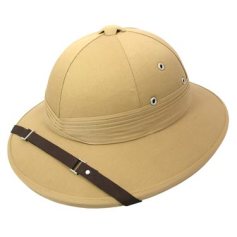
BANG! They don’t like the style.

BANG! They hate the setting.

BANG! The subject is boring.

BANG! They’ve never liked that genre.

Nothing pleases them, they have little or nothing useful to offer, and they leave carnage in their wake. I’ve seen talented writers fall prey to their traps and never rise again.

When you do decide to set off into the wilds in search of the elusive critique partner perfect for you, wear a pith helmet sturdy enough to keep your thoughts encouraged, slather on enough sunblock to protect you from scathing words, and carry clear-lensed binoculars calibrated to let you see the truth in spite of all the verbiage. Wisdom comes with time; there will be pitfalls on the path, and you will suffer injury sometimes, but you won’t find the help you need if you never venture out of the Land Rover.

The best stories are born of adversity.

Crazy how we need to take our own advice. In my former writing group, I really needed to be reminded of this. One writer was working on her next manuscript, and although everyone else brought new material in need of a critique or a polish, she absorbed most of the attention. I stopped bringing anything for the group to read, because they didn’t “do” fantasy or science fiction.

However, I do have a small circle of readers — friends and family — who give honest feedback. Took me a while to train ’em to not be so delicate, but we have a pretty good give-and-take now, and they catch a lot of my errors, for which I am grateful beyond words.

—————————————-

The above was posted several years ago on a different blog. I revised and updated it for this site, and below are a few responses from fellow writers to that original version. Their remarks add to the discussion, and might be of use to the readers today.

DP — “I don’t know what to say. I am at a loss for words. I have a full bottle of Iodine and nothing to pour it on. I now reflect on how upset I got at some of those critique groups who couldn’t see the genius in my verbiage, and realize after re-reading it after a long hiatus how right they were. Very salient post.”

AF — “I get this totally, on several levels. I’ve been a part of far too many writer’s groups filled with people who rarely get any writing done, that or as you say, the “writers” critique with no idea what they’re talking abou…so why do I go? Well the short answer is, I don’t anymore. Like you, I have a few friends that I trust, who read my stuff, and we have an agreement that I’ll read theirs as well…and we go on that a’ way. Works much better than listening to people talk about what they want to write (though they never actual get anything on paper) and then trusting that lot with my manuscripts? No way…”

KB — “I’ve considered ditching any form of round-table-style group,but I can’t seem to totally absent myself from the one to which I’ve belonged for several years. I like these people, but it’s frustrating that they’re more than happy to take my help but won’t give time to my work.

“As for people talking about what they’re going to write, but producing little in the way of actual writing, I’ve been in those groups, too, and had the same reaction: Why put my hard work in the hands of people who won’t do the hard work themselves?”

Writing Your Novel Your Way

Elements of Plotby Terri Main
Elements of Plot
by Terri Main

I recently read the Kindle edition of Elements of Plot: A Personalized Approach by Terri Main, founder of Wordmaster Communications, with a mission of providing writers with “quality publishing and educational services at reasonable prices.”

At 99 cents, Elements of Plot is certainly reasonable, and the material inside is concise, valuable, and fun to read.

First in a projected series (“Writing Your Novel YOUR Way”), Elements of Plot includes a variety of methods to plotting/outlining your novel. It is very readable and well-written–35 pages, so it’s compact– and full of good advice without trying to impose “the” way to approach novel-writing.

Reading books on writing, though useful in many ways, can simply add to the confusion. I’ve read more than fifty of them and if I include articles in Writer’s Digest, The Writer, on blogs and websites, I probably read the equivalent of another fifty or one hundred books in the forty-five years since I first decided I wanted to write things other people would read.

I’ve learned from each of them. Many of them have also confused me. One book was all about plotting and the “proper” way to do that. Another I read, said “plot is an illusion.” According to that author, plot is merely “the accumulated actions the character takes in resolving a problem.” Hmmm… Sounds like a plot to me.

Most require very long and very detailed plot outlines, although the nature of those plot outlines varies greatly. Some look like snowflakes, some like wagon wheels, some are meandering paths, some are written on cards and shuffled, some are pages in a notebook.

Each author has his “one-and-only” way to write an outline.

If you’ve been a writer for any length of time, you’ve run into these one-and-only-way types who just know how a story is supposed to be told. I’ve encountered some recently in a debate over the necessity or usefulness of prologues and epilogues, but that’s a story for another day.

Main is also the author of Creative Calisthenics: A Workout for the Writer’s Imagination, and she recently answered a few of my questions about her new book.

I’m an educator first. One thing we know about education is that different people learn in different ways. The same is true of writing. When I teach magazine writing, I give students six methods of “outlining’ an article. None of which your English teacher told you about. So, I’m very big on adapting to a person’s individual style and helping them optimize that style.

I’ve got a book in outline form right now I’m calling “Noveling by the Seat of your Pants.” No one I can see has written one from that perspective. The big misconception (even among Pantsers) is that they don’t create a plot outline. They do. The plot outline is their first draft. Instead of trying to imagine where the story is going to go and writing down notes, scratching out a line in an outline, and moving around summaries of scenes. They do that with paragraphs and pages.

So, that’s my next big writing book project. This month I’m working on getting a sequel out for another novel.

1. What inspired the series?

Actually, I bought a book on novel writing authored by a woman who taught a class for a major reputable writing school. I started reading it and she was speaking very “authoritatively” about the way to plot a novel. It was a very detailed method planning out every nuance of every scene in every chapter before you began to write anything. Then she said something to the effect that people who don’t do this type of planning simply will not ever be successful writing their novels. They will fail. So, that made me curious about her track record. I looked her up and discovered that aside from the book on novel writing, she had only published a couple of short stories and an article for a literary magazine. She had never actually published a novel.

It started me thinking about the successful authors I knew. Some did do detailed planning, like this author advised. Others made a sort of overview and then filled in the rest as they wrote. Still others “write by the seat of the pants.” As an educator (I spent 30 years teaching college), I already knew different people learn differently. It only made sense that they would approach writing differently as well. That didn’t mean that they couldn’t improve, but that improvement needed to take account of their methodology.

Yet, every book and school out there took the same approach. There was one and only way to write a novel – MY WAY! So, people would grab a hold of one of these methods, and they worked for some, but most got burned out because they were using another person’s tool and not their own. Also, I found that none of the books even recognized that you could write a novel without making detailed plot outlines (of course, only using their method.) So, I wrote a few limited blog posts about the three methods and later expanded it into a short course and then a book.

2. How many books do you think will be included?

I currently have books planned on the following:

Character Development (Character dossiers are fine, but not for everyone. Why not interview a character or discover her as you write?)
World Making (Creating the “world” in which your story takes place)
First drafts, Editing and Revision (Product creation)

And one I am just now beginning to consider adding is Publishing and Marketing YOUR Way. At one time there was really only one way to get that novel published. Find a publisher or agent and hope your novel made its way through the slush pile. That’s still one way, but we have so many others as well. You can go to small traditional publishers who may only publish a few volumes a year, but can give each author a lot of attention.

There are some writer’s collaboratives springing up which share the costs of publishing and marketing, but otherwise run the collaborative like a publisher with standards for publication, etc. Then you can go the self-publishing route and get out a print book on Amazon for as little at $20 and have it distributed to other online sellers for under $100. Or you can go digital and publish ebooks on Kindle, Nook, iPad, Sony and a bunch of other places essentially for free. Each of these has challenges and advantages.

Also a lot of the old rules no longer apply. Self published books in the past simply could not be sold unless you were, say a traveling speaker and sold them after the meetings. Bookstores wouldn’t carry them. But with Amazon carrying just about anything that has been published, you don’t have to worry about the local Mom and Pop not having your book.

I’ve published traditionally with a small publisher and I’ve self published. And honestly, the “respect” that followed traditional publishing helped me get some reviews, but not really a lot of sales. But then, if I want to publish with the Big Houses someday, self-pubbing now might spoil those possibilities. Also some people simply do not have the personality to self-pub. You are in charge of everything. Some of us like that, but others prefer to “just write.”

So, again, there is no one-size fits all approach.

Sounds good to this independent writer!

If you’re interested in any of Main’s other work, here are links to her previous books:Dark Side of the Moon

Death Gets an “F” (A Pinewood College Mystery)

Dark Side of the Moon (A Carolyn Masters Mystery)

Parmenter’s Wager (Science Fiction Short Story)

A Question of Defense (Science Fiction Short Story)

Terri Main’s book announcement blog

She is working on a sequel to Death Gets an “F”, and her traditional publisher has the sequel to Dark Side of the Moon.

So, we are moving along.

And with the various outline methods available — especially in the chapter entitled Creating Detailed Plot Outlines — I have no excuse not to plot my next novel. This pantser had better get crackin’!

Word Desert

Ever experience a writing desert, when all your words evaporate under the glare of reality, depression, insecurity, fear?

I hate fear. It tells me nonsense–“You’re nothing. You can’t write. You speak what no one wants to hear, and write what no one wants to read. You’re a failure.”

Yes, I have failed. Many times. And many times have I faced opposition and conflict, sometimes of my own making, but sometimes the making of others.

Ever been disliked simply because you exist? There was a time, about ten years ago or so, when this verse sustained me:

Do not gloat over me, my enemies! For though I fall, I will rise again. Though I sit in darkness, the LORD will be my light.  -Micah 7:8 (New Living Translation)

An avid, voracious reader ever since my entertainment-oriented five-year-old brain was forced into learning by parents who weren’t afraid of educating me outside the classroom, as an adult I’ve read less and less. There was a time when a stack of books checked out from the library on Saturday might sustain me until, oh, say, Wednesday. Now, however, with the increase in editing work and other life matters, books have been set aside. I’ve even committed the horrific act of halving my library.

Reading for pleasure has become almost impossible. My internal editor must be quieted, and my wide-eyed reader must be set free. It’s not always easy to keep one distracted while the other plays.

And then there’s the dreamy writer, whose far-away thoughts and unfocused gaze too often is overtaken by the sharpish editor, and creativity stunted by protests of correctness or authenticity.

I hate fear.

I said that already. Well, I’ll say it again.

I hate fear.

It represses accomplishment and ingenuity, quashes free thought and individuality, diverts excellence into monotony. Nothing can shine or rise or be different, because anything beyond ordinary attracts attention, and with attention comes attack.

Perhaps that’s why some creators fear success. With success comes criticism. Perhaps they only want praise.

Wouldn’t praise be great? But with accolades often comes apathy, the sense of arrival, ultimate achievement.

So, I’ll take a little praise to keep me encouraged, a little criticism to keep me motivated toward improvement, and a lot of courage to keep slogging–nay, striding–through the desert until the words rain down once more and soak into the hard, cracked soil of neglected imagination.

Eastern Road Rider Magazine

Assumption v. Specificity

I caught this while editing a YA novel this week:

“Same to you, Selly.” He laughs at the familiar nickname as I step off the dock. “Sleep well.”

Goodbye, cruel world!

In truth, the narrator wasn’t stepping off into the lake, but stepping from the wooden dock onto the grassy lawn, and therefore I could easily fix the sentence to make it say what the author intended.

Writers, never assume readers can see the movie in your head.

Although there are assumptions we can make–when people stand, they stand up, for instance; when they sit, they sit down–there are times when specificity is the key to clear, solid writing.

In the case of the example listed above, the author simply needed to tell us this: “I step off the deck into the grass.” Three simple words, and we know the narrator didn’t suddenly go off the deep end. (Groan if you must! :))

By the way, there are instances when characters might stand down or sit up, and then stand or sit need further specification. Otherwise, leave them alone.

What Love Looks Like

This week, I’m visiting family for Christmas, and one might think that, after many months away and long hours of travel to return, I might forego any editing work or writing, and spend all my time in the warm embrace of close kindred.

That embrace has not always been one of comfort, but of control and bought affection. It smothered. It threatened. It even attempted murder.

More than once.

But some of us broke free. We left those we thought we loved, but whom we knew could not love us.

Holidays assayed in their presence often ended in fights and ugly words, and sometimes violence. Our final Thanksgiving with them, my father beat his brother-in-law—not because Dad was spoiling for a fight, but because he was protecting us from an unwarranted and unexpected attack. Thank God Uncle’s head had just been buzzed, or Dad would have grabbed a fistful of hair and beaten Uncle’s head against the gravel driveway.

Lest you feel too much sympathy for him, here are a couple examples of violence against us children: Uncle had tried to hit my infant cousin’s head with a shovel (my aunt turned, shielding her son, and was herself hit with the shovel). Years later, at the aforementioned Thanksgiving, that same cousin’s older brother and I were almost smothered inside a sleeping bag when Uncle wouldn’t let us go.

So you’ll understand why I say, “Thank God Uncle’s head had been buzzed.” I’d rather never see that man again than lose my father for murder.

A later attempt to return for a summer visit—the last time I entered that house, hoping that family could mend—resulted in weapons being turned on us children as a threat to our parents.

That was the first of two times I’ve stared down the barrel of a gun.

Over the years since, we’ve had to learn what love looks like, how it feels, acts, speaks. The old taint tries to creep in every once in a while, tries to steal understanding with impatience, to replace humility with contention. Pride has no place in love, nor does selfish superiority. Love seeks the good of others, not for anything it can gain, but for everything it can give.

tree lighting c. 2012, EE
tree lighting
c. 2012, EE

It’s a shared laugh, a shared burden, even a shared shoulder. Sometimes it speaks just the right words, with or without tangled tongue, and sometimes it holds its peace.

One of the most well-known, oft-quoted definitions of love, one we can all embrace:

Love is patient, love is kind. It does not envy, it does not boast, it is not proud.

It is not rude, it is not self-seeking, it is not easily angered, it keeps no record of wrongs.

Love does not delight in evil but rejoices with the truth.

It always protects, always trusts, always hopes, always perseveres.

Love never fails.

(I Corinthians 13:4-8, NIV)

This holiday season, I wish you peace, hope, and much love.

*     *     *

UPDATE (12-21-12): In an ironic twist, who should call this afternoon but the uncle mentioned in the post above. He wanted to speak with my mother, but she was at work, so he chatted with me. Yes, chatted.

Thirty years, thousands of miles, and a great amount of both reflection and forgetfulness can lead to mutual Christmas wishes. Crazy. And full of grace.


Literary Kerfuffle

So, I unwittingly started a kerfuffle when I posted my response to a literary discussion concerning the “rules” for prologues.

And, since I didn’t toe the expected line, someone presented me with a bit of a finger-wagging scold.

Scold away, I say!

Here’s what the fuss was about:

A gentleman posted a topic for discussion, and in his post he stated, “(S)ome people have made comments about prologues in novels that surprised me. It seems that different people have different views on them and their purpose. Not all novels need a prologue. But for those that have them, to my mind, a prologue is a teaser.”

Then he presented a list of what a prologue should or should not be, and ended with the question, “Agree/disagree?”

Some folks agreed with the list of rules, some took exception to a point or two, and one gentleman gave this response:

A good subject to raise in view of the various opinions expressed elsewhere…True, prologues are often short, but I don’t think the length matters too much so long as the piece is well-written…Prologues seem to fit into some works more than others. Have a look at Ken Follett’s “The small boys came early for the hanging etc” in his prologue to The Pillars of the Earth. If you don’t read it you miss a heck of a lot; it both teases and foreshadows and, in my view anyway, is necessary.

Follett’s sequel World Without End doesn’t have a prologue. I found it interesting to compare his techniques.

Logical, with some backup material to support his remarks.

Then I waded in.

I’m leery of rules. And I’m especially leery of rules that are based on a particular writer’s (or group of writers) preferences.

Although there are some painfully bad prologues in this world, there are many that exhibit fine examples of condensed storytelling.

A prologue isn’t always necessary, true, but if it’s there, it needs to carry storytelling weight. It can reveal history, it can tease future events, it can be a scene that doesn’t fit neatly into the main body of the text, but it must, must, must add to the story.

Arbitrary rules go out the window if they exist at the expense of story.

Someone disagreed:

(R)ules…develop in response to trends & needs, & to avoid chaos. They help prevent newcomers from reinventing the wheel.

The list that started this thread is open for debate – thus the purpose of this thread, so they may or may not represent generally accepted rules.

The “rule” I live by is “you gotta know the rules to break them” (& to know if/when/how/why to break them).

Before breaking them or deeming them arbitrary, it deserves our attention to know if they really are rules, & why they exist.

Before passing judgment on whether rules ought be broken, I think we’re just establishing what basic rules exist in the fiction world re: prologues. Whether to follow them is another matter.

Okay.

I’m all for knowing the rules. After all, they exist for a reason. My objection in this case is notion that prologues have rules.

There are writers who abhor them and writers who love them; writers with poor prologue execution, and writers whose prologues are poetry or exquisite short stories. Prologues are short, long, back story, future action, teasers, packed with information, and so on. Prologues are as different as the writers who write them.

My response:

Who or what is the arbiter of the prologue rules? Is there one? Why must a prologue (or an epilogue, for that matter) be subject to rules, outside of helping to tell the story?

Just as in other areas of life, there are bandwagon issues in literary circles: “never use an adverb” or “never use flashbacks”, and so on.

These “rules” are often preferences, not grammatical or mechanical necessities, or storytelling must-haves.

And though I can advocate for knowing the rules in order to break them well, I still argue that the prologue issue (should a story ever have a prologue, or what must a prologue include?) is not itself a rule, but a preference.

The written word is limited in its ability to convey tone of voice. That is evident in the response below, because the author has read into my words something that didn’t exist when I typed them:

So the opinions here are negated, unnecessary & this is a silly discussion?

…Just because no one’s yet (to my knowledge) written a book about the prologue & laid down rules doesn’t mean some unspoken rules exist…I’d further guess a lot of publishing houses have very definite, articulated rules re: prologues, written for all editors to heed (& break when appropriate).

Preference or not, it’s good to know what the literary preference is, figure out why, & know when to or not to heed it.

By answering here, I’m trying to return to the subject & take the confrontational tone out. Please follow suit.

Well, that’s a head-scratcher. I was never off topic. Never said anyone’s opinion was negated or unnecessary, never said the discussion was silly. Confrontational tone? I can see how my questions might have seemed that way. I objected to imposing rules where none exist.

Nor, in my opinion, should such rules exist. There may be a basic story structure we all employ — beginning, middle, end, with an arc of rising action, climax, and falling action — but we all use that structure to serve our stories, not twist our stories to serve that structure.

Some tales are told inside out. Some are told backward. Some rely heavily on dialogue, some on action. Some are introspective, some spend very little time in the main character’s thoughts. Some have epilogues or prologues. Some use lines of poetry as chapter titles. Some only number their chapters. Whatever works. Whatever serves the story should be used.

I hate seeing young or rookie authors being hemmed in by storytelling “rules” that are imprisoning and arbitrary. One editor said she hates the word atop, and will strike it from every manuscript in which it appears. At a conference several years ago, the keynote speaker (a woman) said that women should not write battle scenes, because women are too soft to write with real grit. One writer likes to keep his descriptions to one sentence, and another likes to invite the reader into the scene by including an entire paragraph.

Different approaches, but certainly none of them following a rule authors can point to in a grammar book or a storytelling guide.

Preferences, not rules.

And I still love a well-written prologue.